

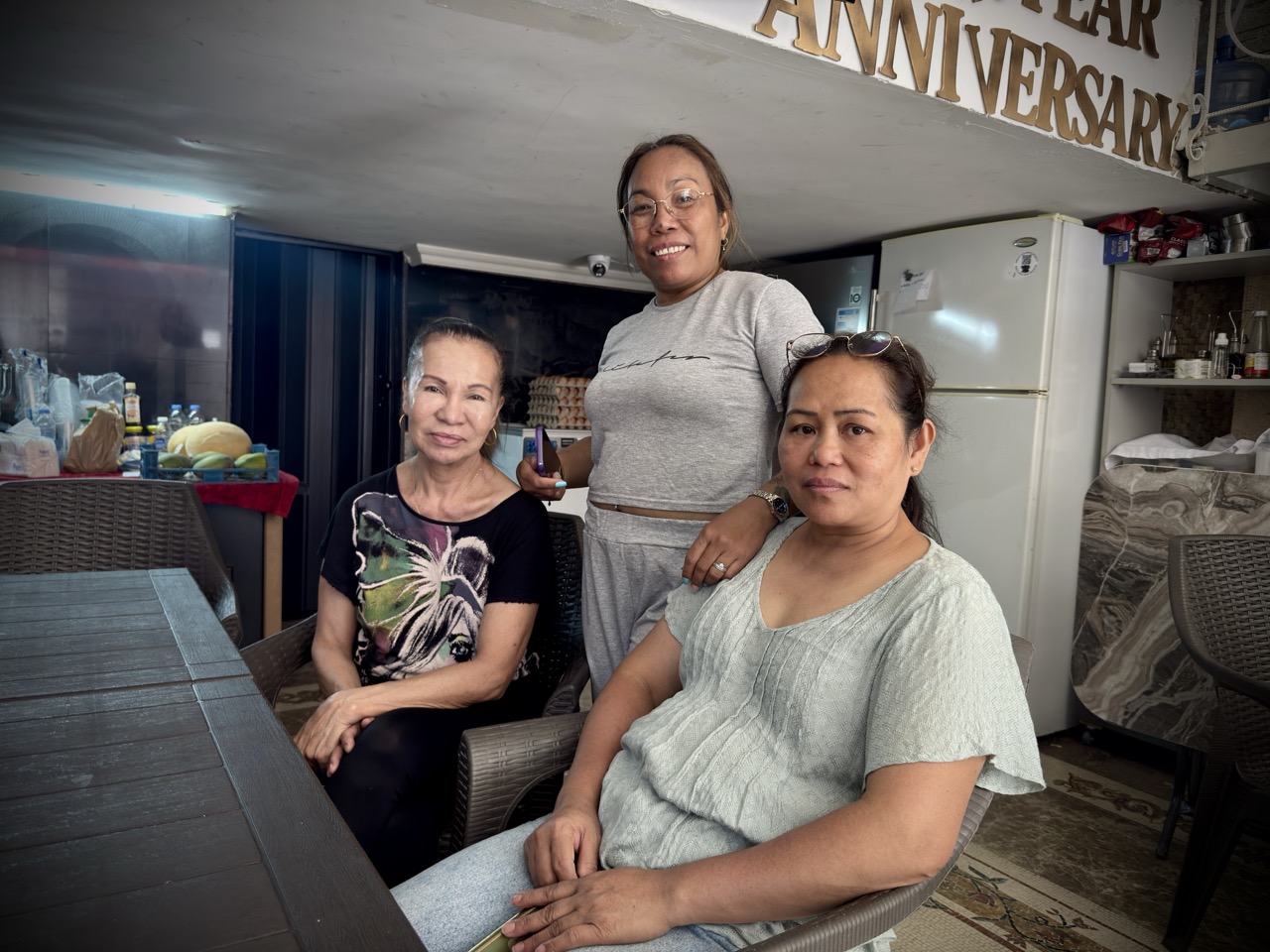
As hundreds of thousands fled Israeli bombardment in southern Lebanon, migrant workers escaped the same war while remaining largely invisible. Their stories reveal a community displaced with nowhere to turn.
By Rayanne Tawil
The small room inside Tres Marias carries traces of many lives.
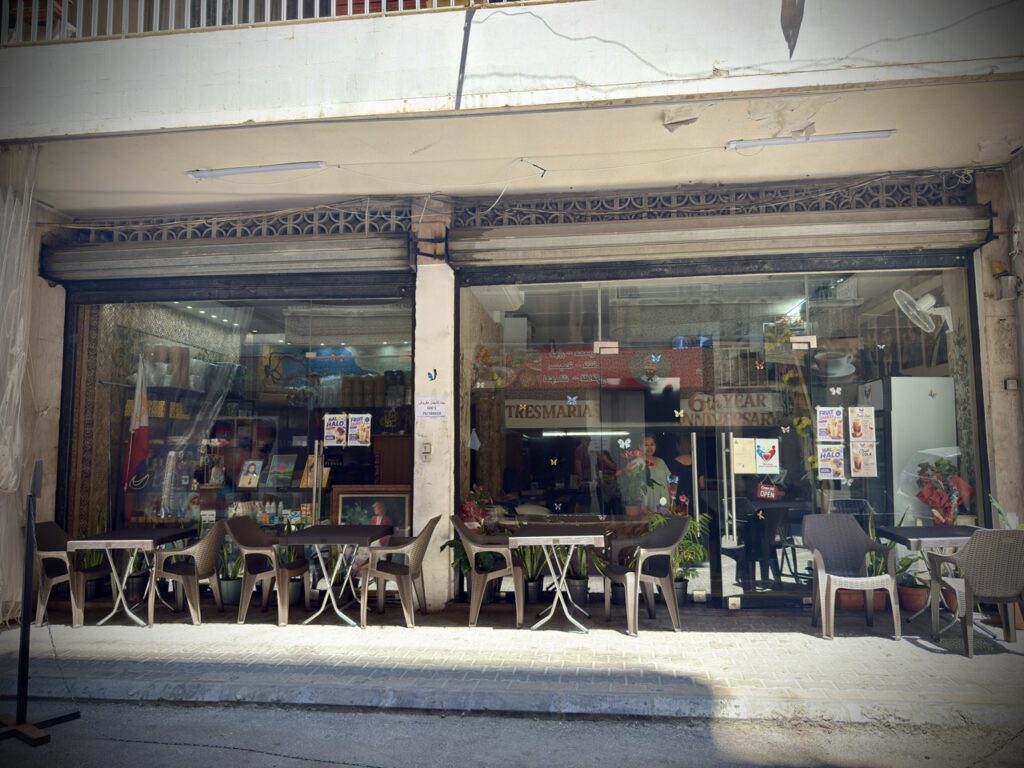
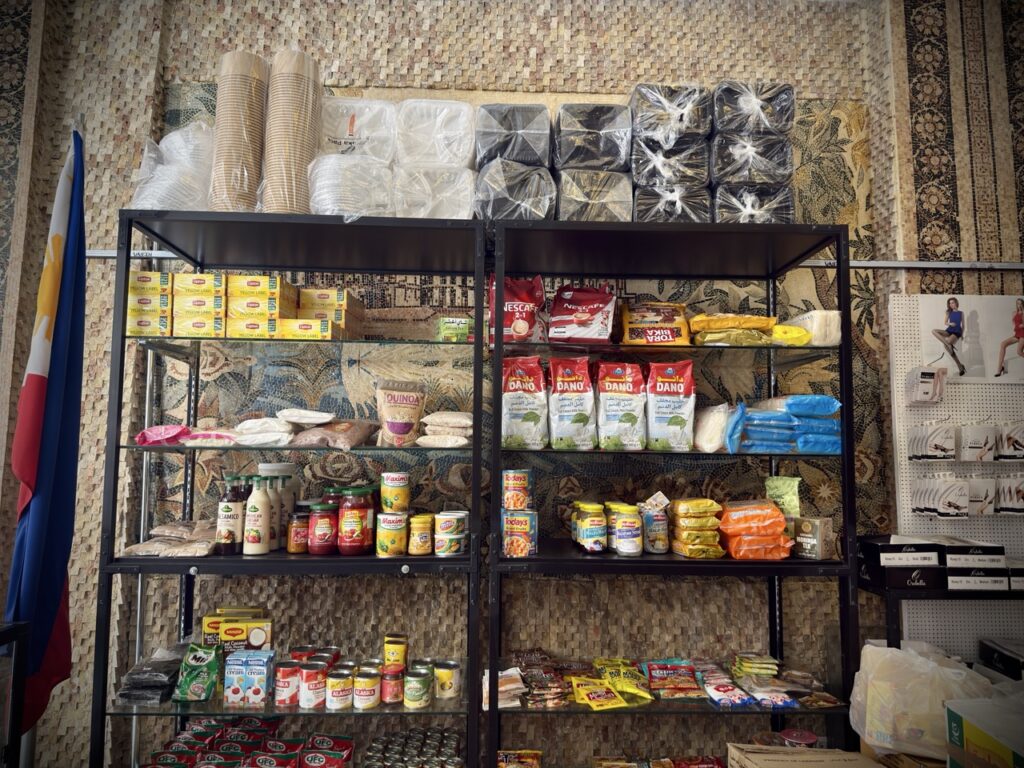
Plastic containers and basic kitchen utensils sit on shelves. Cans of food are stacked nearby. A Filipino flag hangs on the wall, a reminder of a home thousands of kilometers away.
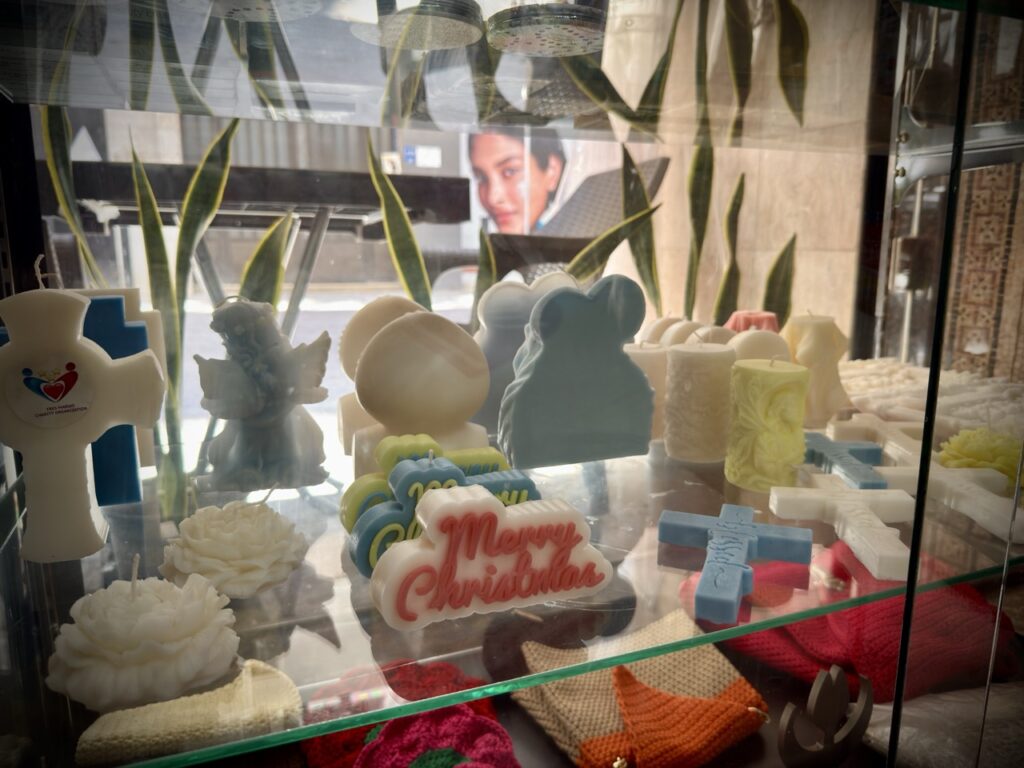
A glass cabinet lined with handmade soaps molded into angels, flowers, teddy bears and crosses. Some carry Christmas greetings, others the logo of Tres Marias, the small Filipino community center established six years ago in Beirut. Each one was made by migrant women who once came to Lebanon searching for work and now use soap making as another way to earn a living.
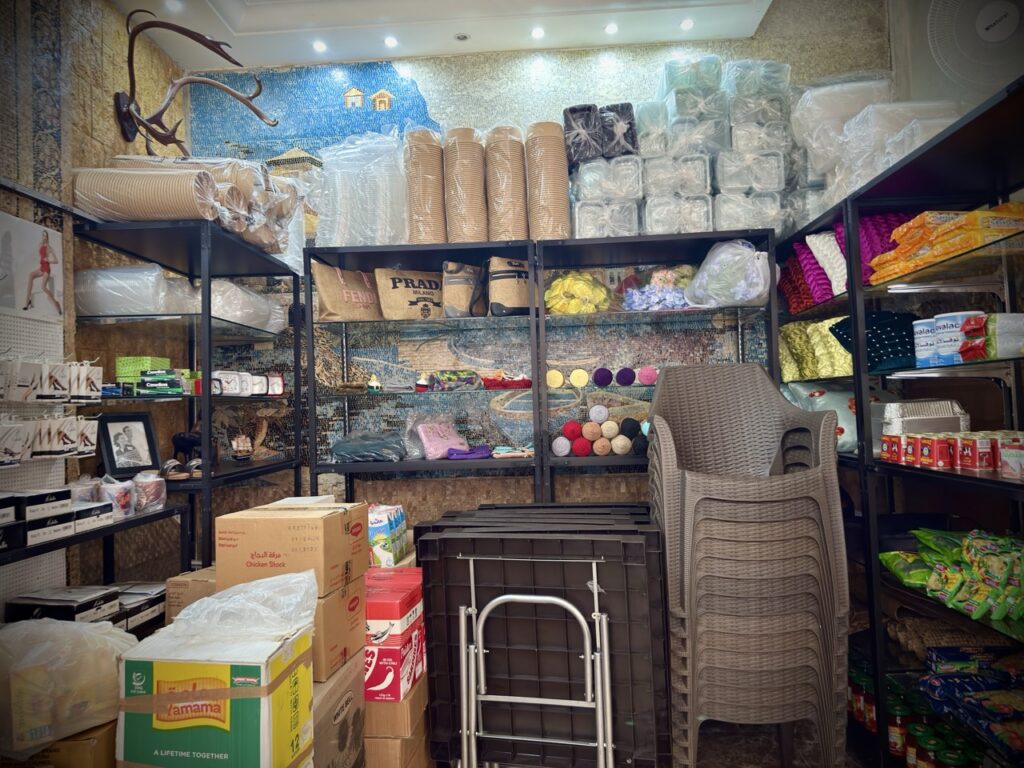
Around the table, the space looks like a kitchen, a gathering place and a refuge all at once.
Evelyn Alhazzam sits on a chair wearing turquoise. Her eyes rarely meet the camera. Her voice breaks as she remembers the night her life changed.
She was in her home in Ghobeiry, in Beirut’s Southern Suburbs, when an Israeli airstrike hit nearby. Her husband was injured. Her children carried him outside.
“We put my husband in the blanket so we could carry him quickly to save his life,” she told Beirut Today.
He later died in the hospital, succumbing to his injuries.
The memory remains visible on her face. As she speaks, tears roll down her cheeks.
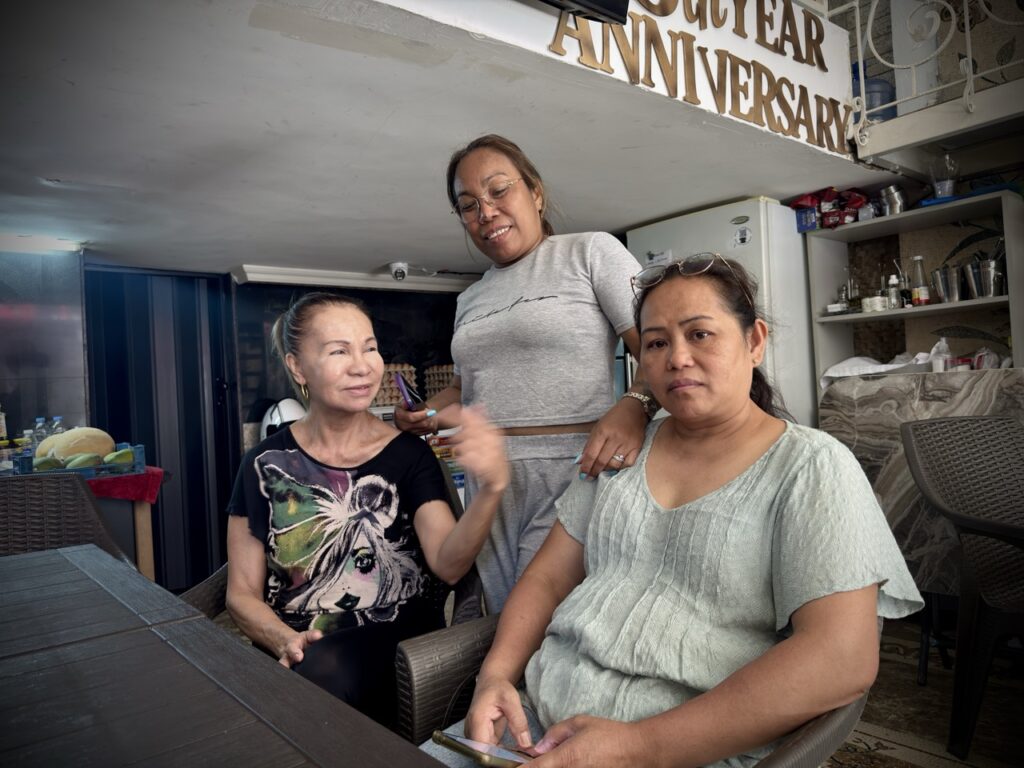
Evelyn, 40, a Filipina migrant worker, spent years in Lebanon. Like other migrant workers across the country, she ended up facing displacement, dread and uncertainty, while also living so far from her own support networks.
Inside Tres Marias, a space made by migrant workers for migrant workers, her story sits there among hundreds of others.
For Myra Aragon, one of the founders of Tres Marias, these stories started arriving through phone calls. “People were calling us at 3 in the morning saying ‘We don’t know where to go,’” she says.
During the war, migrant workers who had lost their homes, or escaped from dangerous areas often had nowhere to turn. Some did not know which organizations could help them. Others feared asking for assistance because of their legal status, financial situation or previous experiences of abuse.
Tres Marias became a point of contact.
“We were receiving calls from different nationalities,” Aragon says. “They were asking for food, transportation, a place to stay.”
The center was never designed as an emergency shelter. It became one because there was a need.
A crisis inside a crisis
Before the bombs started falling, many migrant workers in Lebanon were already living under difficult conditions.
Enu Tsigereda Birhanu, deputy director and a prominent activist at Egna Lenga Besidet, a Beirut-based migrant-led humanitarian and advocacy organization supporting migrant communities, says the war exposed problems that existed long before the first strikes.
“Migrant workers were already forgotten before the war,” she says. “During the economic crisis, many people lost their jobs, they were thrown out like garbage.”
For domestic workers especially, the situation was complicated by the kafala system, which ties workers’ legal status to their employers. When war reached different parts of Lebanon, many migrant workers had no clear evacuation plans, no financial safety net and no family nearby.
“People were asking, ‘Who will come for us?’” Enu says.
She started helping to link displaced migrants with organizations and people that could offer support.
Among those she helped was Hirout Wobshet, 38, an Ethiopian woman who had been residing in Lebanon since 2007. When the fighting got stronger in southern Lebanon, Hirout was in the Jwaya area with her three children.
“There was no electricity. There was no light. It was dark,” she says. “There was no water.”
The lack of basic necessities was combined with fear. The family stayed inside as fighting intensified around them. “They told us to leave,” she says. “They told us to leave the area.”
For three days, Hirout says she lived through an increasingly dangerous situation. She was worried about her children, whose ages 12, 7 and 4 years old. “I was in a very bad condition,” she says. “I was sick and I couldn’t go out with my kids. My kids got sick too.”
Eventually, she was evacuated by ambulance from her home.
Today, she is back near Sour, though the place she returned to no longer resembles the home she left behind.
“My home is barely there; everything fell down,” she says.
Her belongings, her stability and her sense of security disappeared with the war. “I have never seen anything like this in my life,” she says. “I have seen everything in my life here.”
The road out of the south
For some migrant workers, displacement did not happen through an organized evacuation. It happened through a series of desperate decisions.
Mohamad Hmaidan, 45, a Sudanese father, has been in Lebanon for 20 years and during the war he stayed in Sour almost 100 days.
His first thought was his children.
His youngest son was born during the war and was only five months old when the situation became unbearable.
“I don’t have a place to live,” he says. “It was very difficult for me to find a place.”
With his family, he eventually left the south. For several days, they searched for somewhere safe to stay.
At one point, Mohamad ended up sleeping in a parking lot in Raouche. “I only had a small bed with me,” he says. “We would sit there. At night, we would watch the kids sleep.”
The image stayed with him: a father sitting outside with his children, trying to protect them while having nowhere to bring them.
His wife had recently given birth. Their baby needed milk and diapers. They had nothing. “All my belongings were left behind,” he says.
The family eventually returned to Sour, to a damaged home that no longer felt like the same place. “I changed a lot,” Mohamad says. “I’m afraid that the war will come again.”
For him, safety became the only thing that mattered.
“I just want my children to go to a safe place,” he says. “I want them to live a good life. I want them to study.”
Walking with nowhere to go
Hasan Abkar Ishaq, 41, another Sudanese migrant worker, was living in Qana with his wife and children when the war started. Before all this, he was working in agriculture and living in a small house that was given to him by the people he worked for.
When the attacks intensified, he did not immediately know what was happening. “I didn’t know that the war was going on,” he says. “The people didn’t tell me anything.”
It was only after receiving a phone call from people in Beirut that he understood the scale of the situation. “They told me the whole world is going crazy,” he says.
When he went outside, he found himself trapped. His car had no gasoline and there were no taxis available. “I suffered a lot,” he says.
The journey away from the south became a long road with his family.
From Sour, they moved toward Sidon on foot. From there, they took a bus and eventually reached Beirut, where they slept under the Cola bridge.
“We were walking, walking, and walking,” Hasan says. “That was the most difficult thing.”
He remembers carrying his children while trying to figure out where they would sleep next.
“I didn’t have money,” he says. “I didn’t have travel expenses.”
Support eventually came from organizations that provided food, diapers and assistance, yet the uncertainty remained. “The displaced families are suffering a lot,” he says. “They are not getting a job. They don’t have a car.”
For Hasan, the war added another layer of vulnerability to a life already built around uncertainty. “I only depend on myself,” he says. “I don’t have anyone close to me.”
The people who were never counted
The stories of Evelyn, Hirout, Mohamad and Hasan are different in their details; however, they share the same feeling: being left to navigate a war that had already taken away their sense of stability.
For Enu, this was one of the biggest challenges during the war. Migrant workers were often absent from official conversations about evacuation and displacement.
“They are living here. They are working here. They are part of this society,” she says.
But when the fighting spread, many struggled to access information.
Some did not know where shelters were located. Others did not have money for transportation. Many were separated from their communities, unable to contact their families or employers. “We had people calling us saying they were stuck,” Enu says. “They didn’t know what to do.”
The problem was not only the lack of resources. It was also the lack of recognition.
For years, migrant workers have built their lives in Lebanon while still staying on the margins. They clean homes, care for children, work in agriculture and help keep households going across the whole country. During the war, many ended up displaced alongside Lebanese families, with their own experiences too often missing from the bigger picture.
At Tres Marias, those tales piled up, one phone call after another, never really stopping. Aragon recalls women who were afraid to step outside their homes, workers who had nowhere to sleep and people who had lost all connection with their families.
One moment still stays with her.
“When we arrived at one shelter, the children were already waiting on the balcony. When they saw us, they shouted, ‘Food! food!’ They told us they had been waiting for our food because it tasted like home.”
Today, the organization’s work has not really slowed down at all. Tres Marias continues organizing fundraising dinners, handing out dry meal parcels and giving aid for rent; meanwhile, many migrant workers are still unemployed, or they are just earning a smaller piece of what they used to make before the war. “I get paid $400; it’s not enough to cover our expenses,” says Hirout.
For Aragon, the struggle is still going. “Peace does not mean the crisis is over,” Aragon says. “Many lost their jobs. Others had their salaries cut. They still need help.”
The organization tried to connect them with food, transportation and emergency support, but the demand was far beyond what a small community space could handle. “We were trying to help as much as we could,” Aragon says.
For many migrant workers, the war also brought back older wounds.
Hirout’s story reflects the vulnerability many domestic workers face even outside moments of crisis. She describes years of difficulties with employers, including struggles over her passport, salary and living conditions.
“I came here when I was 17 years old,” she says. “I have never seen anything like this in my life.”
The war made everything heavier.
She worried about returning to Ethiopia, where she felt she had no future, while Lebanon no longer felt secure. “I want to teach my children,” she says. “How can I teach them?”
Her future remained uncertain. She wanted to leave, then leaving required money she did not have.
“The situation in Ethiopia is not better, and I can’t leave,” she says. “I have no money, and they will not pay for my ticket.”
Her words describe a situation faced by many migrant workers: trapped between a country that has become home and a place of origin where returning does not necessarily mean safety.
After displacement, rebuilding from nothing
For those who returned after leaving, the end of active fighting did not mean the end of displacement.
Mohamad went back to Sour, yet his home had changed.
The fear remained.
“When a child sees someone dead in front of him, it’s a difficult situation,” he says.
His children carried the memory of the war with them. Like many parents, he centered his hopes on a future with no violence.
“I want my children to go to a safe place,” he says.
For Hasan, rebuilding also meant starting again with very little. After moving between places during displacement, he eventually found work again in agriculture.
He describes the help he received from organizations as essential. They provided food, diapers and shelter when he had nothing.
Still, the uncertainty of life as a displaced migrant worker remained. He worried about rent, work and his family’s future. His experience also revealed another difficulty migrant workers face during emergencies: many had no family network in Lebanon to rely on.
Lebanese families often left affected areas to stay with relatives in safer regions. Migrant workers frequently did not have that option.
They had to search for help through organizations, strangers or community networks.
A place built from the gaps
Back inside Tres Marias, the stories return to the same room.
The space was created around community, though the war transformed it into something larger: a place where people could ask for help when there was nowhere else to go.
For Aragon, the biggest lesson from the war was that migrant workers needed to be included before a crisis happened. “They need to be part of the conversation,” she says.
The war did not create their vulnerability. It exposed it.
Their stories show another side of displacement in Lebanon: people who had already crossed borders to build a life and then somehow found themselves needing to move again when the violence came right into their neighborhoods.
Evelyn still carries the memory of that night when she lost her husband, remembering the pieces. Hirout remembers leaving her home with her children in an ambulance.
Mohamad remembers sleeping outside on the streets with his newborn. Hasan remembers walking with his family because there was no car, no fuel and no clear destination.
Their experiences are different, but each story begins with the same question: where do you go when the place you built your life in disappears?
At Tres Marias, that question remains present.
The Filipino flag still hangs on the wall. The shelves still hold cans of food. The chairs are still arranged around the small room where people come to talk, ask for help and remember what happened.
Evelyn sits there, looking down, her turquoise shirt standing out, bright in the quiet room. The war took her husband, and the room keeps his memory.
