

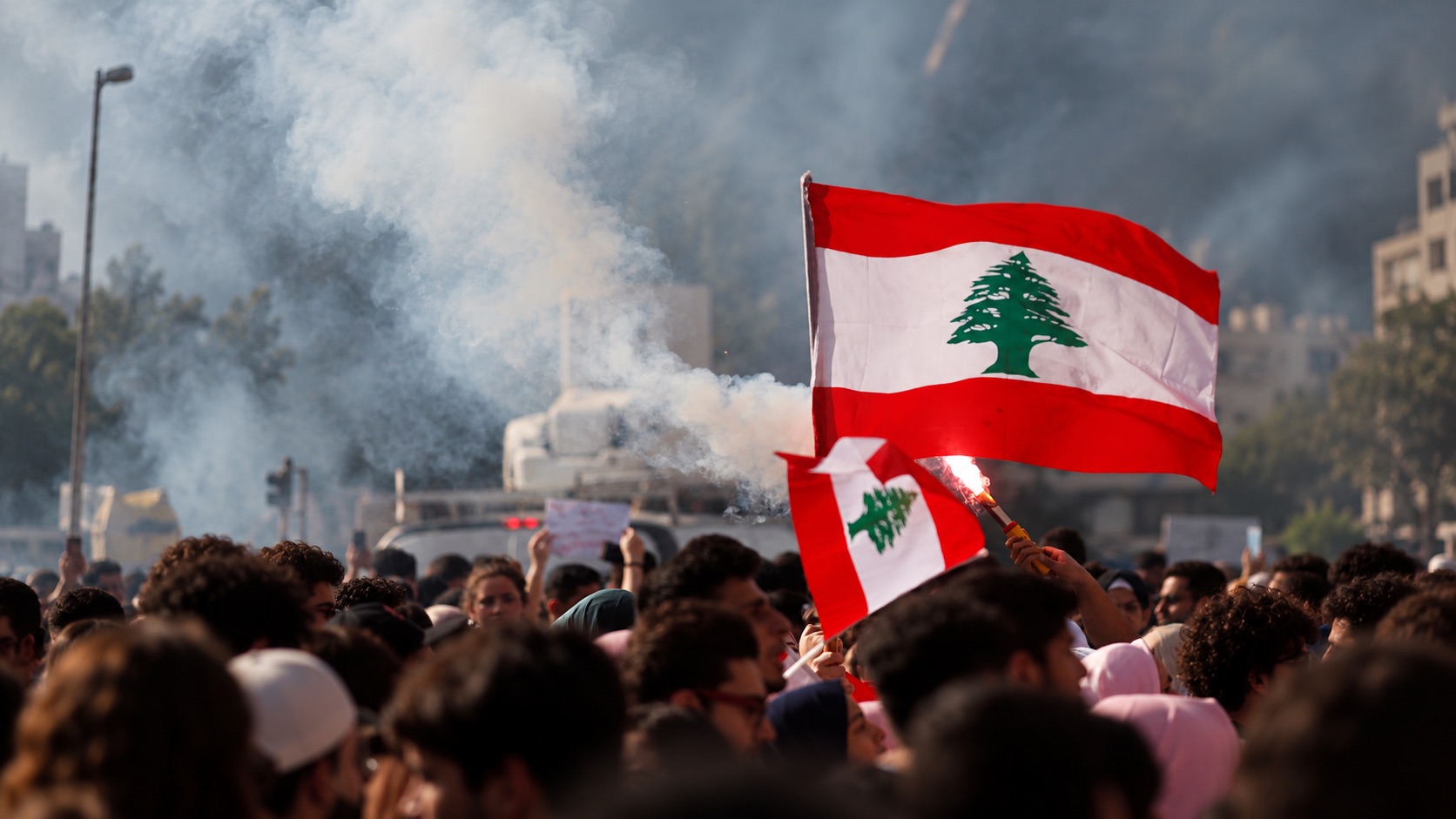
I am a 17-year-old Lebanese-American student currently commencing my senior year in high school. I have resided in the United States for the past four years, but I was born and raised in Lebanon throughout my childhood. As an American citizen, I was fortunate to move to the US in search of greater stability amid the gradual breakdown of my home country. Living in the US opened my eyes to the diversity of cultures, beliefs, and perspectives that shape different communities. It has also deepened my passion for Arab politics, because the distance created introspection, which led me to understand the US role in Lebanese politics. In addition, the Israeli-Palestinian war shook my political personality and tightened my connection to Lebanon’s political landscape. This is further coupled by my familial and personal experiences during much of the country’s political turmoil while growing up: the October 17 uprising, the August 4 port explosion, COVID-19, etc.
Growing up in a relatively rigid and strict political environment back in Lebanon, I was taught to idolize a series of somewhat demagogic ideas concerned with sectarianism, questions of martyrdom, and resistance. In contrast, after moving to the US, I encountered the other extreme, where people either showed little sympathy for Arab struggles or refused to extend grace and open-mindedness. Over time, I learned that the problem is not necessarily ignorance itself, but an enclosed mindset, defined by a person’s unwillingness to grow through understanding other people’s perspectives. I believe that we have a collective social responsibility to use our voice to bring people together.
After discovering a community at my school here in Boston that shared similar cultural backgrounds and interests, we established the Middle Eastern and North African (MENA) club to promote cultural diversity and raise awareness of conflicts affecting our peoples. For instance, when the Gaza genocide escalated, we organized fundraisers and bake sales and created posters to raise awareness and support Palestinians in Gaza. Through these modest efforts, we raised over $1,300 in donations merely from high school students in our school.
However, the escalation of the conflict raised tensions within the school community, particularly in history class. On the day after October 7, my history teacher emailed the entire class to inform us that we would discuss the event. I still remember sitting in class, where the silence felt deafening. The teacher spoke with distress, acknowledging the terror that Israelis experienced that day; however, he did not bring up the decades of exclusion and suffering Palestinians had faced. For years, Palestinians had experienced their own ‘October 7′ without receiving proportional media coverage, and I felt that it was my social responsibility to initiate a discussion and educate my own teacher about the history behind the conflict. I pulled him aside and began explaining my perspective. I admired how composed he remained, and, surprisingly, he agreed with everything I had said. However, I noticed his hesitation to bring the issue to the rest of the class’ attention, and it was clear that he felt the need to be cautious. That’s when I realized the ways in which empathy and freedom of speech can be selective with regard to the plight of Palestinians.
I took this discussion to mean that I needed to stay true to myself, stand by my beliefs, and challenge social conformity. It was nerve-wracking to speak my mind, especially as the class remained silent the entire time; however, I couldn’t help but feel satisfied with how the conversation turned out. It showed me that there are people in this world who are willing to listen, engage in difficult conversations, and learn from different experiences. But it also revealed a more complex story that awakened my skepticism about the two forces limiting our role and critical scope as an Arab diaspora.
Challenging Complicity and Numbness in America
We were assigned to write a speech in my literature class about important global events. Without doubt, I chose to speak about the erasure of the Palestinian people. In context, I had friends whom I did not yet know were passionate supporters of Israel. Once they found out about my topic, they decided to double down. Our teacher gave the class the option to present our speeches, and our group, along with one other student from the classroom, were the only ones who agreed to do so. When the day of the speeches arrived, I felt my heart pounding and my hands shaking. I could sense the tension in the classroom, as well as my classmate’s dissatisfaction with my position. As I began speaking, I kept my head up and maintained eye contact with the class. After my speech ended, I returned to my seat – most were attentive and supportive, with the exception of the opposing pro-Israel team. Since then, there have been interpersonal discussions between classmates.
A few months later, I enrolled in the most challenging History course offered at my school, which was really fast-paced, and we often had to read difficult excerpts. Toward the end of my sophomore year, my teacher assigned an in-class project in which we had to create a documentary and website explaining the context of an important topic about which we were passionate. I viewed that assignment as an opportunity to elaborate a broader understanding of the Palestinian plight. Some of the pro-Israel students discovered my choice. One of the students had a father who held a position in the local town government; he was well-known within the school community. After they found out about my topic, that person reported me to the principal in an attempt to have me suspended. The situation was left unresolved, and the principal did not take action.
Bedford is a diverse town; however, my experience showed a lack of acknowledgement of Arab struggles when contrasted with other racial struggles. Although I found my community, it took time and effort to build friendships. I even had a couple of negative experiences with teachers, both of whom taught English. During my sophomore year in 2024, the war in Lebanon escalated, and it became extremely challenging for me to manage school while keeping in touch with my family. After I finished giving a presentation, I asked my teacher for a pass to see the counselor. I couldn’t stop crying and remained there until class ended.
The Other Side: Pressure for ‘Authenticity’
However, this experience of alienation in the USA is not necessarily paralleled with support by everyone from our home countries. While there is a sense of pan-Arab and pan-Islamic solidarity among peoples in the diaspora, and a global sense of wanting justice after decades of colonialism and racialization, there is also a sense of having to prove ‘local authenticity’ by being forced to support the politics of despots and reactionary forces in our Middle East contexts.
For instance, as a Southern Lebanese, I was taught to follow an ideology that romanticizes resistance in spite of the cost. The idea of resistance itself is crucial when faced with the increasing threat of occupation and the resurgence of a new form of colonialism, but can it still be approached in the same way when we’re watching our homes and country fall into a cycle of death and destruction partly because of an armed group’s choices? Is it resistance when our death tolls become nothing more than a statistic instead of a reflection of human beings who once had dreams and aspirations? No one is denying Israel’s long-standing predatory behaviour toward Lebanon; however, my own perspective – informed by my experience as someone who lost their house in the outskirts of Beirut’s southern suburbs- is that reigniting this regional war only added fuel to the fire; it didn’t deter Israel in either Gaza or South Lebanon. In thinking of these questions and reflections, I had criticized Hezbollah numerous times for contributing to pushing the country into a state of war, practically providing Israel with an additional pretext to continue its war of erasure on Lebanon.
In opposition to this skepticism, many people have become so attached to ideas of identity and authenticity that they align themselves unquestioningly with groups who claim to represent them. In response to my criticism, some within Arab diaspora circles, even those my age, have had the audacity to label me as someone reinforcing ‘the perpetrators’ who literally bombed my family’s house. It seems – even for those distant from the actual conflict taking place in Lebanon – that authenticity is symbolic more than it is material. For me, our actual belonging to the land is tied to experience, existence, and memory. I am not less Southern Lebanese for criticizing a political party that neither advanced the country’s safety nor brought the war to an end. I am South Lebanese by virtue of having lost a part of my memories to this disastrous experience.
Exiting Exile: In Defence of Critical Reflection
These aren’t narratives on equal footing; we can’t claim there’s a symmetry between Israel’s US-backed genocide and the Arab militarism that responds to it. But the stories associated with them do undermine our capacity to think for ourselves, to be purposeful intellectuals rather than mere empty responders on social media, or cowards in response to social pressure.
A connection between these two narratives is that neither allows much room for critical public opinion. Both use the language of political violence, despite Israel implementing it today on a greater scale. They also treat this conflict as an endless battle, one with no clear resolution or progress. Our focus should be the lives of the victims, not a romanticized understanding of violence that desensitizes people to war and continues to glorify sacrifice as if we were distant observers. Sacrifice is important, especially in politics – one cannot engage with the public without sacrifice. But sacrifice should be goal-oriented and effective. It is no longer an effective sacrifice when the endless promise that we will reach the end goal is never realized.
We owe it to ourselves to continue striving for change, despite the constant pressure to remain silent and avoid challenging conversations. Students like me aim to find a sense of universal justice in the face of racialization and indifference in the West, while also challenging the idea of romanticizing rigid notions of ‘authenticity’.
A common similarity between individualism in parts of the West and the pressure to maintain authenticity within the Arab world is that both cultures can judge individuals who think outside the box. We need to search for ideas and solutions rooted in universal principles that address the root causes of our conflicts. We deserve better.
