

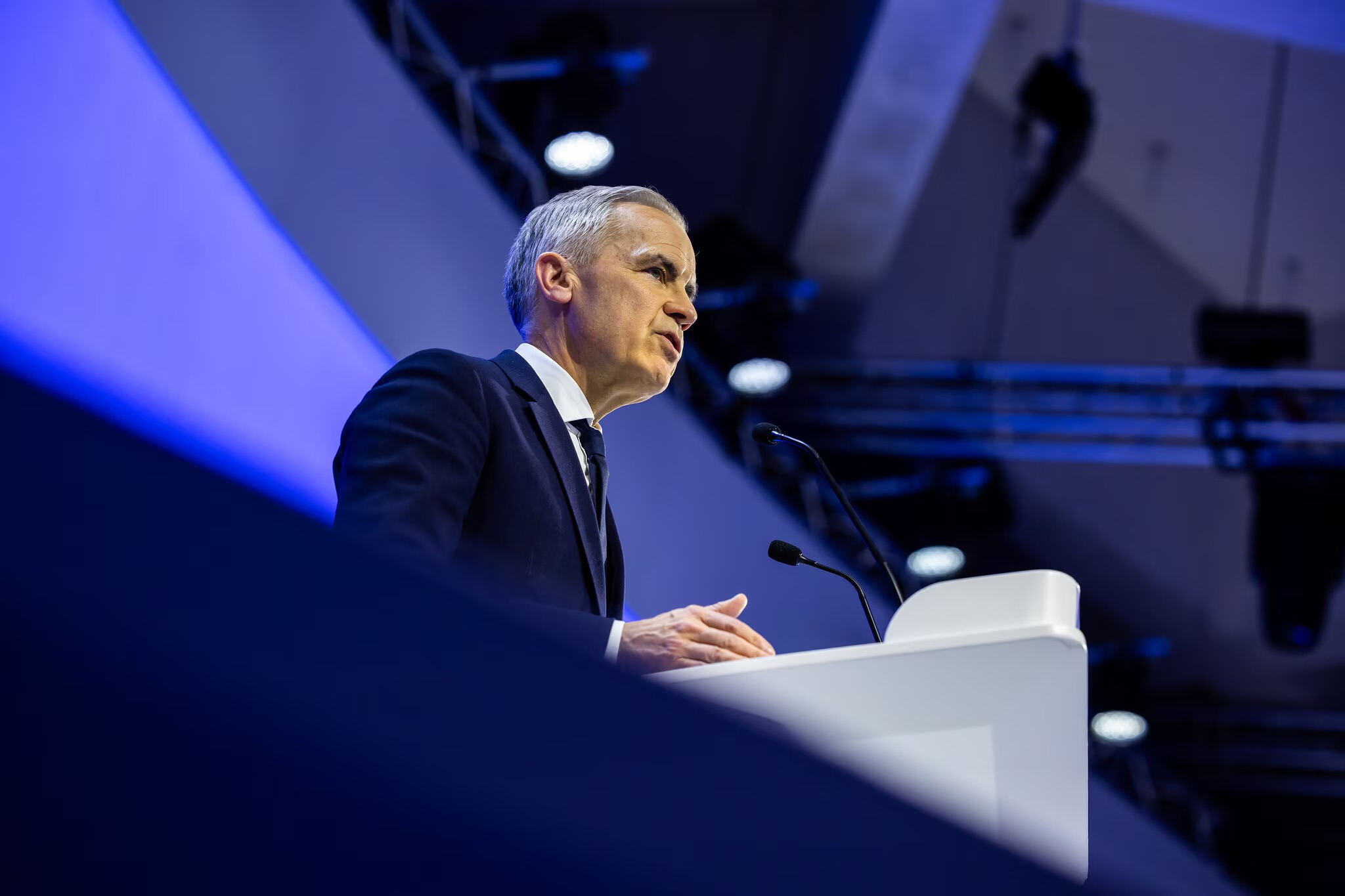
World leaders have gathered at the annual summit in the Swiss city of Davos, at the background of unprecedent tension withinthe North Atlantic Treaty Organization and a growing European realization of the breaking of the multilateral rich world orderand the expansion of wild unilateralism, particularly from the United States.
The summit came as the US, under Trump’s administration, unilaterally took the decision to invade Venezuela and capture its president Nicolás Maduro and more recently announced plans to conquer Greenland, a territory of the Kingdom of Denmark and therefore of both the European Union and NATO.
Canadian PM Carney’s Speech
Canadian Prime Minister Mark Carney delivered a speech that contained what many considered an essential and soberingperspective.
In his speech, Carney admitted that the “rules-based order” has been partially false, and highlighted the identity-based selectivity in how international law is applied, admitting that Canada and its counterparts have avoided calling out the gaps between reality and rhetoric, with that bargain no longer working.
He added that the (western) world is in the midst of “a rupture, not a transition”, and that one “cannot live within the lie of mutual benefit through integration when integration becomes the source of your subordination.”
Reactions to the speech from ones highlighting it as outstanding and “one of the best” they’ve heard, to others highlighting how the world order was considered “ok while everyone else was suffering” and that admitting fake-preaching human rights and democracy for one’s own benefit and reversing course when one becomes the victim warrants no sympathy.
Carney emphasized that Canada will continue to support Ukraine, being “one of the largest per capita contributors to its defense and security”, as well as Greenland and Denmark, fully supporting their “unique right to determine Greenland’s future.”He also emphasized Canada’s commitment to NATO’s article 5, which states that an attack against one of the organization’s members shall be considered an attack against all members.
Toward the end, the Canadian PM called for states to “stop invoking rules-based international order as though it still functions as advertised” and to “call what it is: a system of intensifying great power rivalry, where the most powerful pursue their interests using economic integration as coercion.”
He called for states to act consistently, stating that when “middle powers criticize economic intimidation from one direction but stay silent when it comes from another, we are keeping the sign in the window.”
French President Macron Rejects Trump’s Greenland Pressure and Highlights Weakening Multilateralism
French President Emmanuel Macron highlighted a state of weakened multilateralism, (hybridized) conflict, security and economic instability, and increased autocracy away from democracy and what he described as “a shift towards a world without rules, where international law is trampled underfoot, and where the only law that seems to matter is that of the strongest and imperial ambitions are resurfacing.”
Macron highlighted competition coming from the US through economic coercion and aims to weaken and subordinate Europeand from China. He named the solution to such issues more cooperation and building new approaches, and building “more economic sovereignty and strategic economy especially for the Europeans,” which he considers “the core answer”.
The French President vowed support for Denmark, and highlighted imbalances reflected in development gaps, claiming that “aid that neither delivers sufficient results nor enables countries to escape poverty” is not something that can be settled for.
Belgian Prime Minister Bart De Wever echoed similar sentiments and warned Europe that it can’t assume the US is still a reliable ally.
Too Little Too Late?
The speeches, although described as sobering or intelligent by many, have also received their fair share of criticism.
Such criticism pointed out that Western world leaders should have already known that what is termed “the rules-based order” was already proven false during Israel’s genocidal campaign in Gaza, and throughout decades of Western military and political interventionism in contexts across the globe. Such perspectives highlight that Western states’ realization came too little too late, only when they became the victims of such a Hobbesian systemthemselves.
However, both criticism and potentials for revamp can co-exist. In other words, even if some states realized the shambling state of international law only when it concerned them, it could still be a realization that could go hand-in-hand with the Global South’s struggle for more equitable, sustainable, and multilateral international relations.
