

By Marie Saadeh
To understand the spirit of the Lebanese people, you need to look no further than Fairuz. In his 2003 documentary We Loved Each Other So Much, Dutch filmmaker Jack Janssen turns the camera toward the people whose lives are touched by her music, introducing us to Beirutis across political and religious backgrounds to capture a country healing from civil war. Both a loving portrait of Beirut and an exploration of the liberating force of music, the film continues to move audiences some twenty years after its release. In this interview, Janssen reflects on the making of the film and how it resonates today.
Can you speak on what informed the idea for We Loved Each Other So Much. How did you initially hear about Fairuz and her influence in Lebanon and the region?
I had listened to Fairuz’s music–and it gave me goosebumps. But I also heard about Fairuz because I joined a friend of mine in making a film; it was a student project on the West Bank, and it was about the daily life of a family under occupation.
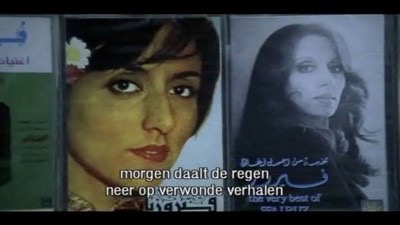
I remember, for example, that when you walked into a house, and you went into a bedroom, there was nothing on the wall except this one picture of Fairuz torn out of a magazine. From [this], I got this impression of this divine figure above the worlds, who people love. That also gave me the idea to make a film about the love for Fairuz, or the meaning of her music for the people. To build an image from the stories of the people.
Of course, by then there was already 50 years or more of Fairuz’s music. From my perspective, as an outsider from Western culture, that’s quite exceptional. There’s no good equivalent in Western culture. That gives this feeling that her music is in the DNA of people.
The idea to make the film also had to do with the way the world was moving, the social and political context. The film gives this oral history of Beirut, and the 15 years of war. This idea has very much to do with the different sects, [questioning if one could] relate to these different people who have been fighting each other for so long, and letting them talk about their love for the same music. The idea that people are shooting each other and on both sides are listening to the same music–how does that work? That was the final impulse. Within this kind of world setting, this feeling–which also here in the Netherlands, for me at least–by that time was growing. It was a very important voice to show, not only for [Lebanon], but also for the whole world.
How does We Loved Each Other So Much fit within your broader practice as a filmmaker?
In my work, I like to oppose the ideal to reality, and image to reality, and that’s very much in the concept of the film. But it’s also in Fairuz, in her figure, and in her songs; the great romantic feelings as opposed to the harsher reality, and the longing for something which is hard to get, and which may be. And [that theme is found in] the [film’s] central song “Sabah Wu Masa.”
In a sense, [the song] is about melancholy. What do you do with melancholy? The song reveals a pain, but there’s also this opening to something which you strive to or had wanted in the past, or still want, and this opening is very important. There’s still light somewhere, even if it’s only in your imagination.
What was your process for shooting each interview?
People maybe don’t realize that this was shot on 16mm film. Because it costs money and you only have 10 minutes on a roll, very few people still work on film. There was one shooting period, I think maximum three weeks, so it was very restricted. You can see that in the film; we had so little time to shoot with people. If there would be a Fairuz 2 then I would work with much more material and time to [develop] the personal stories [of the interview subjects].
There’s a moment in the film where the Palestinian man being interviewed asks you directly, “Do you want to exploit my story in a film about Fairuz?” before speaking on his displacement from Palestine in 1948. It was an acknowledgement of your position as an outsider. Did you experience hesitation from your subjects?
I will come back to this idea of the “outsider,” but I doubt, actually, if [his] response had much to do with me being an outsider. I think it was more the feeling [of] ‘why [ask about] Fairuz, why music, while we have this problem and this agony?’
In this scene, I think we ask, “Are you still wanting or hoping to come back?” I don’t know if you notice that he responds, “Back where?” The film was made over twenty years ago, and [even then] coming back to Palestine [seemed] so far off. That says something about this history and what is happening now.
You mentioned that you’d like to revisit this idea of the “outsider.”
Fairuz was a figure who, in 15 years of civil war, managed to remain above the parties. But this means, in fact, she was an outsider. The position of an outsider can be very important in sectarian societies. Also in Holland and Europe, societies have become much more sectarian. If you do not belong to a sect and if you, like me, don’t accept [sectarianism] and try to build bridges or move from one to the other, then the more sectarian a society becomes, the more difficult the position of the outsider.
I think [Fairuz’s] way of staying an outsider can have a very healthy influence on societies. In that sense, [she can be considered a] voice of resistance.
Do you know if the film has ever reached Fairuz herself?
Definitely the rough cuts. It was actually quite special because, of course, you have no idea what will happen [when she sees the film], but she laughed quite a bit and it was a very nice meeting. She gave [the film] her blessing.
That’s amazing. Did you always intend for Fairuz to view the rough cut?
No, the concept of the film, and her whole personality, was [about] staying outside and not participating in public life, and I wanted the film [to reflect this]. But what I did want is maybe at the end of the film to include her image, and that’s why we tried to get in touch with her. Finally that worked, and we could show her a rough cut.
But then she said, “I love the different stories and people, but I cannot be part of them. I have to stay outside.” That was her explanation to not be in the film herself.
