

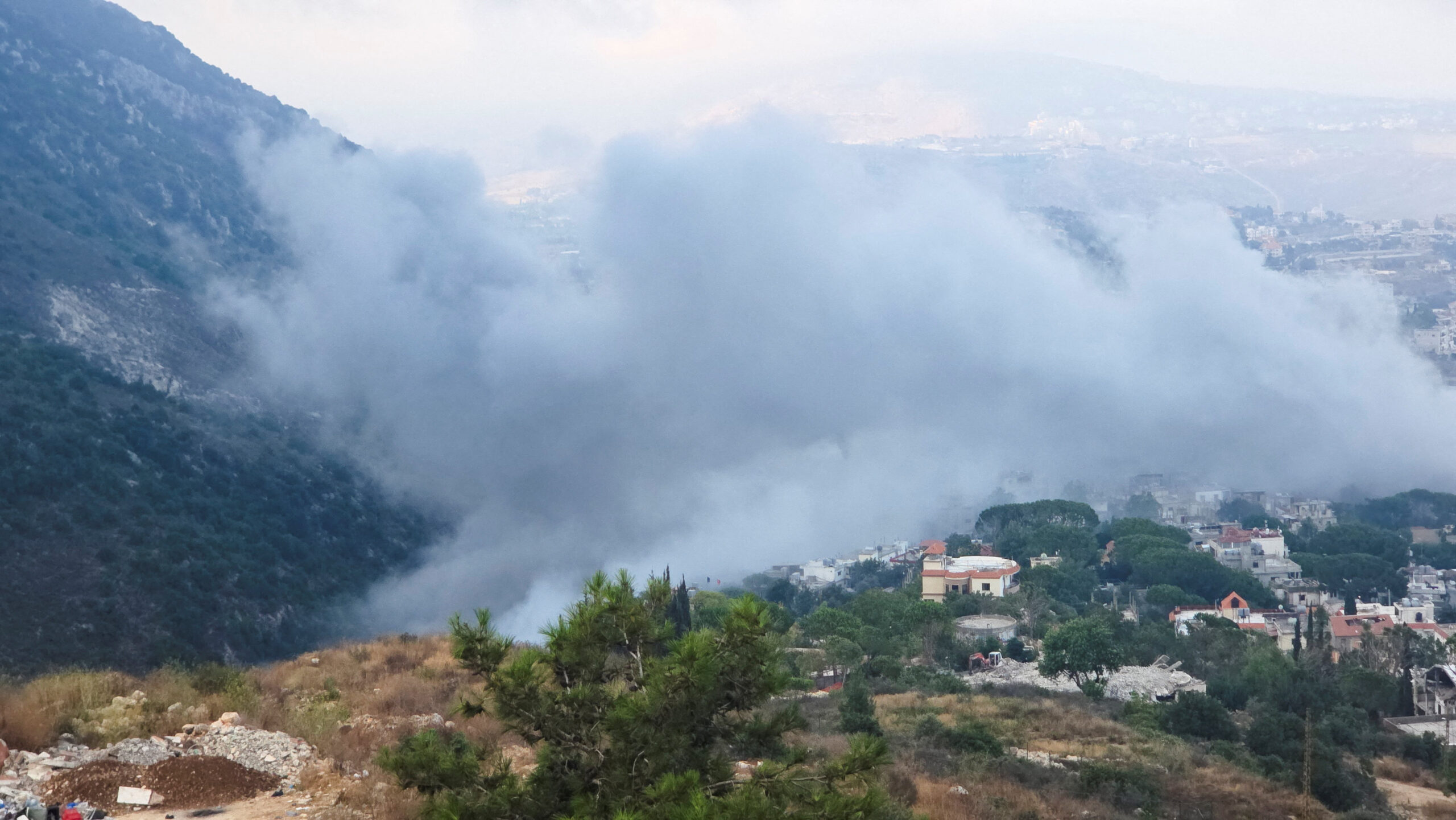
Israeli airstrikes on the southern Lebanese town of Kfar Rumman killed 11 people, including two children. Nine people were killed when Israeli warplanes struck a residential building in the town. A separate drone strike targeted a civilian vehicle, killing two medics inside. At least five other people were injured in the attack on the residential building.
In addition, the Israeli military issued a forced displacement order to people in Deir el Zahrani, instructing them to move outside a circled area with a 300-meter radius.
Renewed Israeli Escalation
The attacks and forced displacement order come amid a significant escalation in Israeli attacks on Lebanon over recent weeks. This morning, Israeli forces targeted the towns of Qantara, Deir Seryan, and Beit Yahoun, while Israeli soldiers blew up houses in Mansouri.
These attacks also come against the backdrop of a diplomatic impasse, with negotiations, whether through the trilateral framework involving the United States, Israel, and Lebanon or through other diplomatic tracks, seeing little-to-no progress.
Additional waves of displacement are expected amid this renewed escalation. As of September 1, the International Organization for Migration’s Displacement Tracking Matrix Mobility Tracking exercise, complemented by data from national systems, including the Lebanese Red Cross and Disaster Risk Management, had identified more than 300,000 displaced people.
The town of Deir el-Zahrani lies north of the city of Nabatieh and Ali al-Taher Hill, where security conditions have deteriorated. It also sits outside the so-called “security zone line.”
Accordingly, displacement and fears of military operations are expected not only in areas where Israeli forces are present or regularly conducting operations, but also in nearby towns and villages across the South Lebanon and Nabatieh governorates, and potentially in the Bekaa and Baalbek-Hermel governorates.
Displacement rates do not depend solely on the continuation or cessation of military operations. Many areas have suffered from the complete or partial destruction of residential buildings and critical infrastructure, severely limiting access to basic items and services.
The failure to address ongoing ceasefire violations also raises further questions about the viability of the pilot-zone operations and the sustainability of any political efforts to bring the hostilities to an end.
