

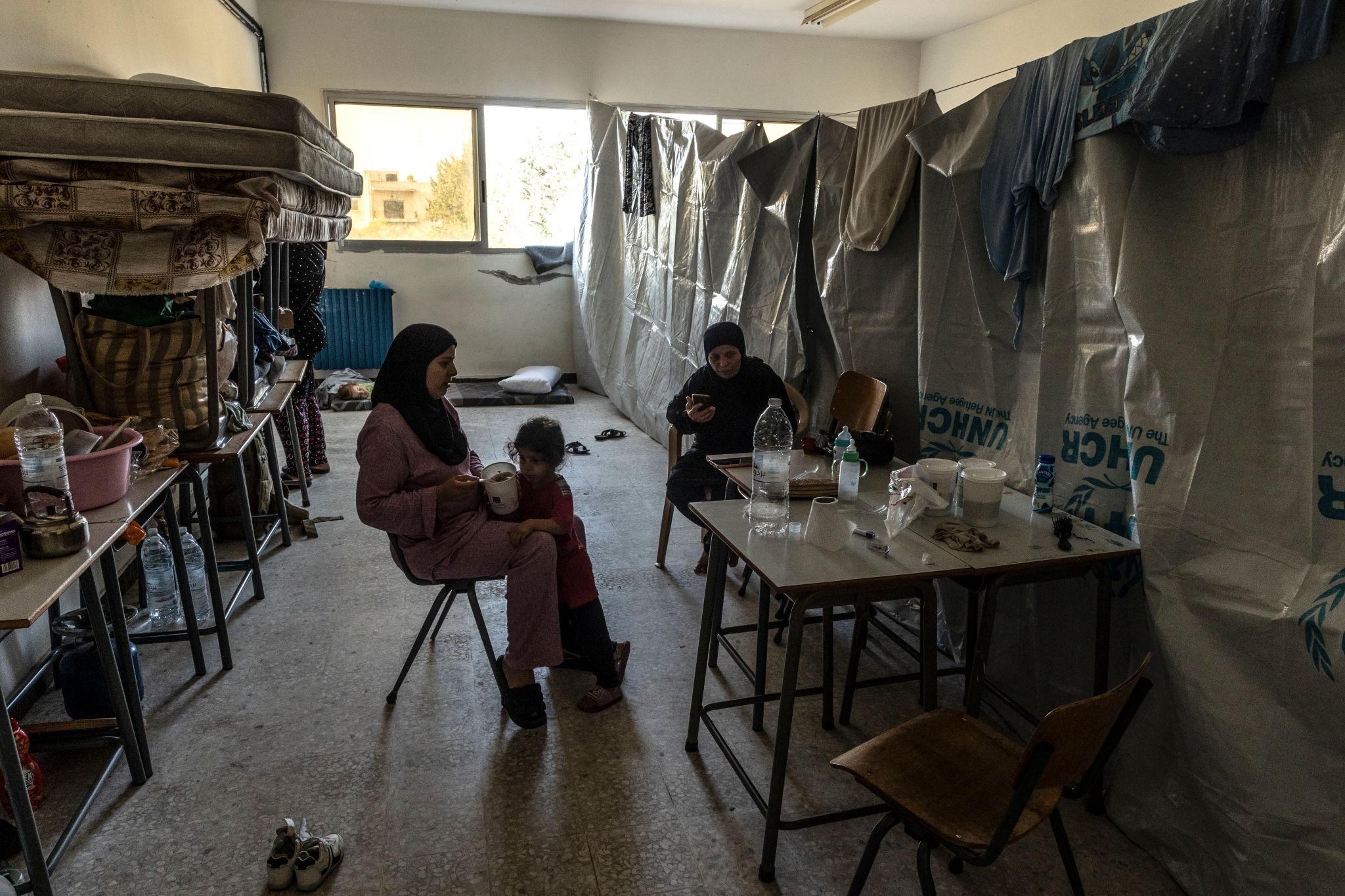
As thousands fled Israeli airstrikes, many survivors of domestic violence delayed seeking help while overcrowded shelters, displacement and financial hardship heightened the risk of gender-based violence, aid groups say.
By Sally Abou AlJoud
BEIRUT — The war forced “Maya” to leave her home, but it did not end the violence she says she faced inside it. She said her husband often grabbed her forcefully during an argument, leaving bruises on her arms. It was not the first time, she said, that his aggression had intensified when the family was forced to leave their home under fire.
When Israeli strikes escalated over Beirut’s southern suburbs in March, “Maya,” whose real name was changed to protect her identity, as she said she feared the consequences of being identified, fled with her husband and three children, aged four, seven and nine, carrying only a few belongings. Their home was later destroyed during the war, leaving the family with no place to return to.
Maya said her husband repeatedly threatens to divorce her and take their children away. In their current living conditions, where the family is confined to a single room in an apartment shared with over a dozen other people, arguments often happen in front of the children.
“He lowers his voice so the others in the apartment don’t hear,” she said. “But there were times when he didn’t care and shouted at the children and me loudly.”
Maya said she never reported the abuse because she feared the stigma it would bring to her and her family, and worried that her husband would use it against her by taking away her children.
Only urgent cases sought help
As Israeli airstrikes forced tens of thousands of Lebanese families to flee their homes this spring, many women carried more than bags of belongings. Like Maya, they also carried the burden of abuse – often with nowhere safe to report it.
For many survivors of domestic violence, escaping bombs became the immediate priority, pushing abuse behind the urgent need to find shelter, food and safety for their children. Aid workers say the violence did not stop during the war. In many cases, it intensified.
“The priority was keeping themselves and their children safe from airstrikes and finding shelter,” said Celine Al-Kik, a social worker and support center supervisor at KAFA, a Lebanese organization that provides legal, psychological and social support to survivors of gender-based violence.
When fighting between Israel and Hezbollah escalated in March, calls to KAFA initially fell sharply as the organization closed its offices due to the bombing and shifted services online and by phone, Al-Kik told Beirut Today.
“Only very urgent cases would call us,” Al-Kik said. “Women were busy figuring out where to escape, especially the cases in the red zones. We noticed that women experiencing violence would not report it unless something extreme happened.”
Rania Irani, response technical officer at ABAAD, a Lebanese NGO working to end gender-based violence and promote gender equality, echoed this, saying: “Many delayed seeking help after experiencing violence because their immediate priority was protecting their families, finding shelter, and securing food and medicine.”
During the war, local organizations expanded emergency support for survivors despite widespread displacement and disrupted services.
ABAAD said it reached 10,144 people, women and men, through gender-based violence prevention and response activities, including awareness sessions in collective shelters and host communities across all eight governorates.
Meanwhile, KAFA said it deployed outreach teams to 26 collective shelters in coordination with Lebanon’s Ministry of Social Affairs, providing information on protection, safety and available support services. Al-Kik said the visits also created opportunities for women experiencing psychological or physical abuse to come forward and seek help.
Psychological abuse intensified
ABAAD also documented a shift in the type of abuse survivors reported, Leila Hamdan, response technical lead at the organization, told Beirut Today.
“The most concerning trend is the sharp rise in psychological and emotional abuse during the war,” Hamdan said. “Before the conflict (based on data from the first two months of the year), psychological abuse represented 47% of reported GBV cases. During the war (March–June), this increased to 65%, making it the most commonly reported form of violence.”
Higher risks and greater numbers of reported cases were observed in areas experiencing large-scale displacement, particularly the South, Beirut and Mount Lebanon, the North, and the Bekaa, Hamdan said.
“The most significant increase in psychological abuse was recorded in Beirut and Mount Lebanon, while high caseloads were also reported across Tyre, the North and the Bekaa,” she added.
Women displaced to collective shelters faced additional risks, including overcrowding, a lack of privacy and shared sanitation facilities that made it harder to seek help confidentially. Some were forced to remain in the same shelter as the person abusing them.
KAFA said it encountered one such case involving a woman who fled to a collective shelter with her family but continued to face “severe violence” from her husband. “We followed up with her and provided legal and social psychological support,” Al-Kik said. “Through a judge, we were able to relocate her and her children to another shelter, barring the husband from approaching her.”
ABAAD’s Hamdan added that its later analysis showed “a substantial increase in the overall number of reported cases during the war compared with the pre-war period.”
While conflict, displacement and the pressures of war initially kept the number of reported cases low for KAFA, the severity of the violence reported against women intensified during this period, Al-Kik said.
Displacement heightened protection risks
Maya and her family first sought shelter with relatives in central Beirut before her husband rented an apartment shared with two other families. The family of five now sleeps in one bedroom. With rent covered only until the end of September, Maya said they do not know where they will go next.
She said the stress of displacement – which they had already experienced in 2024 – financial hardship and uncertainty have intensified her husband’s aggression during their more than 10-year marriage. He has long struggled financially, she said, but each displacement has worsened his behavior toward her.
Displacement heightens protection risks for women and girls, rights organizations say.
According to UN Women, more than 85 percent of displaced women and girls in Lebanon in 2026 were living in informal housing arrangements, where overcrowding, limited privacy and inadequate protection mechanisms increased their exposure to harassment and gender-based violence. At the same time, barriers to accessing protection, support and justice services often become more pronounced as the risks of violence escalate.
“The conflict, displacement, overcrowded living conditions, financial hardship and prolonged stress further heightened the risk of intimate partner violence and other forms of gender-based violence,” Marie-Lise Abi Abdallah, implementation officer at ABAAD, said.
The agency estimated that around 390,000 of those displaced were children, while women and girls accounted for approximately 620,000 of the displaced population during the peak of the escalation. The United Nations Population Fund further estimated that 325,500 displaced women were of reproductive age, including around 13,500 who were pregnant.
UN human rights experts cited by the Office of the United Nations High Commissioner for Human Rights also raised concern over statements by senior Israeli officials targeting Lebanese women, particularly mothers, warning that rhetoric portraying civilians as collectively responsible for armed groups’ actions risks dehumanization and undermines protections under international humanitarian law. They stressed that civilians must not be treated as legitimate targets or subjected to collective punishment.
Prolonged impact
Even after the fighting eased, the effects remained.
Al-Kik said conflict often worsens violence inside households as families struggle with displacement, economic hardship and prolonged stress.
Many women returned to damaged homes or remained displaced, while others continued to face financial hardship, psychological distress and abuse.
By early July, the UN reported that around 40% of the more than one million people displaced by the 2026 conflict had returned home, while hundreds of thousands remained displaced.
“You feel like the war hasn’t ended yet,” Al-Kik said. “There are still many people displaced, and many women are still facing challenges.”
In July, the UN said more than 33,000 people were still living in collective shelters across Lebanon, with many others staying with relatives, renting, or in informal arrangements. Returns have been limited because many homes, especially in parts of south Lebanon and Nabatieh, are damaged, unsafe, lack basic services, or are near areas where security remains uncertain.
“Even after the ceasefire, many continue to deal with the long-term psychological and economic impacts of the conflict,” ABAAD’s Abi Abdallah told Beirut Today.
Lebanon’s conflict GBV preparedness
Aid workers say the experience of both the 2024-25 and 2026 conflicts exposed longstanding weaknesses in Lebanon’s ability to protect women during emergencies.
According to UN Women, the mass displacement caused by Lebanon’s 2024–2025 war significantly increased protection risks for women and girls.
As around 1.2 million people were forced to flee areas affected by airstrikes, displaced women and girls faced greater exposure to gender-based violence due to overcrowded collective shelters, limited privacy, restricted access to essential services and weakened protection networks.
UN Women warned that displacement conditions, compounded by stress, economic dependency, power imbalances and reduced access to support services, created conditions in which risks of violence, exploitation and abuse could intensify. More than half a million displaced women and girls were identified as particularly vulnerable, with reports of sexual violence, domestic abuse and other forms of gender-based violence increasing throughout the crisis.
“The conflict exposed the need for stronger emergency preparedness, better gender-sensitive shelter infrastructure, and more equitable access to GBV services across Lebanon,” Hamdan said.
Existing economic pressures, damaged infrastructure, staff displacement and uneven service availability made it harder for survivors to access timely support, she added.
The risks facing displaced women and girls during Lebanon’s 2024–2025 war were compounded by longstanding gaps in the country’s legal and protection systems.
Before the conflict, Lebanon’s main legislation addressing violence against women – Law No. 293/2014 on domestic violence, amended in 2020 – had been criticized by rights groups for its limited scope, weak enforcement and remaining legal gaps, including the absence of explicit criminalization of marital rape.
In March 2024, lawmakers and women’s rights organizations proposed a broader law on violence against women aimed at strengthening protections, improving access to justice and establishing specialized mechanisms for survivors. Still, the legislation had not been adopted before the recent war began.
