

Ireland has won admiration across much of the Arab world for sounding, at times, like the European state most willing to confront Israel over Gaza. It formally recognised the State of Palestine on 28 May 2024, established full diplomatic relations with Ramallah, and said the move was made against the “tragic backdrop” of Gaza’s devastation. It also went on to intervene in the ICJ genocide case, and Israel responded by shutting its embassy in Dublin in December 2024, citing what it called Ireland’s “extreme anti-Israel policies.”
That is the image: principled, brave, unusually clear. But the reality is less flattering. Ireland’s real policy towards Israel is not one of confrontation; it is one of calibrated symbolism. Dublin has mastered the politics of moral outrage while carefully limiting the economic and legal consequences of that outrage. The result is not courage but duplicity: a state that wants the reputation of resistance without the cost of acting like it.
Start with the most basic contradiction. While Irish ministers condemn Israeli conduct and invoke international law, Ireland’s commercial relationship with Israel remains substantial. Parliamentary data cited in June 2025 put Irish goods imports from Israel in 2024 at about €3.8bn, with most of that trade concentrated in electrical & electronic products, primarily Integrated Circuits. Reporting based on CSO figures said the total was €3.83bn, and that more than 95 percent fell into the category of “electrical machinery, apparatus and appliances.” For a government that speaks as if Israel is uniquely beyond the pale, that is not incidental trade; it is a major commercial relationship. In 2025, Ireland remained Israel’s second-largest destination for export goods, behind only the USA.
The usual defence is that Ireland is targeting the settlements, not Israel as such. But that argument only exposes the gap between rhetoric and action. In June 2025, the government published the general scheme of a bill whose main purpose is to prohibit the import of goods from Israeli settlements in the occupied Palestinian territory. Yet the same official Irish statement, citing the ICJ’s July 2024 advisory opinion, explicitly notes that states should abstain from economic or trade dealings that may entrench Israel’s unlawful presence and should take steps to prevent trade or investment relations that help maintain that illegal situation. In other words, Ireland’s own legal rationale is wider than the law it is willing to write.
That narrowing is not accidental. That is the whole point. The proposed measure was sold as historic, but even sympathetic coverage noted that imports from the settlements affected by the bill amounted to just €685,000 in total between 2020 and 2024. By February 2026, Reuters reported that the still-delayed, goods-only version of the measure would catch goods worth only around €200,000 a year. So the “tough” Irish response that generated headlines is, in material terms, almost negligible. Dublin has chosen the one sanction that maximises symbolic value and minimises economic impact.
Worse, even this trimmed-down response has been repeatedly delayed. Reuters reported on 5 February 2026 that Ireland’s attorney general had raised “significant” legal and practical issues about extending restrictions to services, while ministers again stressed that any legislation had to be legally robust and able to withstand challenge. That caution may be legally understandable. But politically and morally, it reveals a government determined to move no faster than absolutely necessary, even as it continues to cultivate an image of exceptional principle.
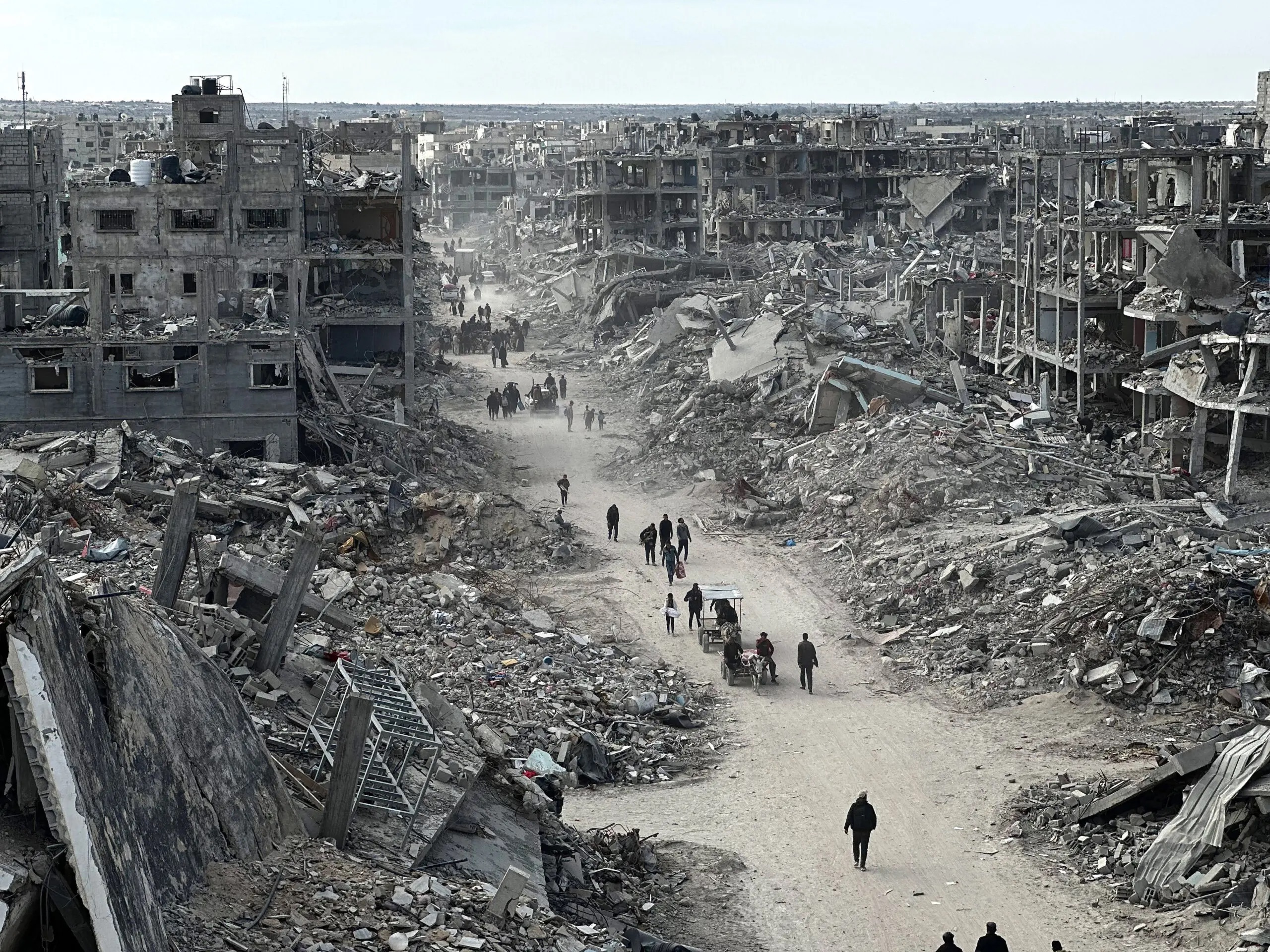
And all this unfolds against a human catastrophe that has long since stripped “incrementalism” of any credibility. UNICEF said on 5 February 2026 that 71,803 Palestinians had been reported killed in Gaza since 7 October 2023, including at least 21,289 children. When the scale of slaughter is this vast, a government cannot plausibly claim to be acting with urgency while confining itself to a delayed, ultra-narrow measure aimed at a tiny sliver of trade.
None of this means Ireland is as complicit as governments that have armed, financed, or politically shielded Israel at every stage. It is not. Ireland has, at least rhetorically, been far ahead of most of the EU. But that is precisely why its evasions matter. Because Ireland has wrapped itself in the language of international law, its refusal to impose meaningful costs on Israel turns into something far more sinister than timidity. It is hypocrisy masquerading as leadership.
If Dublin wants to be taken seriously, it must stop conflating diplomatic theatre with accountability. Recognising Palestine matters. Speaking at The Hague matters. But neither offsets the fact that trade continues, the sanctions are tiny, the loopholes are obvious, and the political will remains carefully rationed. A state that truly believes Israel is violating international law should not be content with symbolic friction. It should be prepared to impose material consequences. Until then, Ireland’s posture is more performance than genuine solidarity.
