

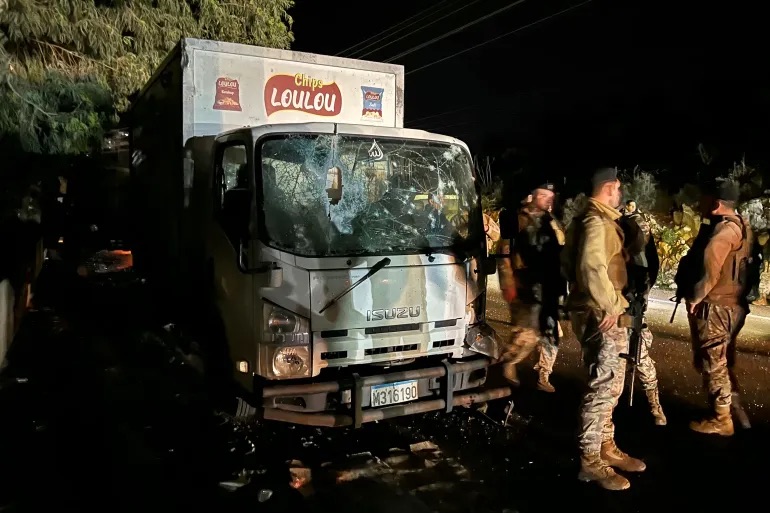
Over the last few days, Israeli attacks have continued hitting areas in southern Lebanon, impacting residents of these areas and causing extensive damage amid continued Israeli occupation of regions near the border.
Yesterday, an Israeli drone dropped a stun grenade on the outskirts of Naqoura. On Tuesday, attacks included an Israeli drone strikes hiting different cars on the outskirts of Adaisseh town in the South and Jadra town in the Chouf district, and incendiary shelling hitting the outskirts of Adaisseh as well.
At least two individuals were killed on Tuesday as a result of Israeli attacks: Hussein Qotaish, assassinated in the Chouf district and mourned by the Amal Movement, and another person in the town of Markaba in the South. Israeli forces also infiltrated 600 meters inside the Blue Line and planted booby-trapped boxes in the town of Dhayra before withdrawing. The Lebanese Army then established security parameters and detonated the munitions, according to Megaphone.
This is taking place while remnants from the past escalations over the past two years continue to impact Lebanese residents, such as the explosion of a device in the Laylaki neighborhood of Beirut’s southern suburbs today (which left no casualties).
Lebanese Speaker of Parliament Nabih Berri considered the Israeli raids targeting areas in the Bekaa governate and the south as a message directed to the conference in Paris dedicated to supporting the Lebanese Armed Forces today while, in parallel, forming a “ring of fire” on the eve of the Mechanism meeting scheduled for tomorrow.
Concerns Rise Over Travel Advisory Changes
As concerns over a renewed escalation remain, Lebanese residents noticed an update of the United Kingdom Foreign Office’s travel advisory to Lebanon on Tuesday, whereby it cited risks of military escalation across the country and overall worrying security developments.
The UK particularly advised its citizens not to go to several areas such as Beirut’s southern suburbs, the Bekaa and Baalbek-Hermel governorates, Palestinian camps, many parts of Beirut such as Tarik el Jdideh and areas nearby, and the North and Akkar governorates.
The update also cited a number of “serious risks” and matters to take into consideration for British Nationals in Lebanon, including access to the Beirut Rafic Hariri International Airport and civil disorder.
Limited Changes in Public Stances
As time progresses, Hezbollah’s leadership issued different statements, which some might consider contradictory. On one hand, Hezbollah Secretary General Naim Kassem voiced full support for the state. On the other, Kassem asserted that arms will not be withdrawn, claiming that the group keeping the arms is an end in and of itself.
Today, representatives from France, the United States, Saudi Arabia, and Lebanon will meet in Paris amid fears of an Israeli escalation in Lebanon.
Recurrent meetings between international actors invested in Lebanon and the region have hitherto failed to produce significant changes in the country’s status quo. Israeli occupation and attacks continue unabated, killing and injuring residents across the country, preventing many displaced people’s return to their houses, and damaging critical infrastructure and service delivery.
Discussions on pathways towards state monopoly over arms, Hezbollah’s disarmament, and the role of the Mechanism remain deadlocked. However, steps by Lebanese Armed Forces have been increasingly noticeable as they examine sites identified by the Mechanism.
Some analyses also suggest that the recent crackdown by the army on drug channels, including the recent arrest of famous drug lord Nouh Zeaiter, is part of an overall strategy to pressure Hezbollah-related income sources to coerce the group into engaging constructively in political talks and solutions.
The state of affairs on that front is not only dependent on changes inside Lebanon, but also on the course that Syria takes in the upcoming months and years, including but not limited Lebanese-Syrian coordination on border demarcation, smuggling, and broader border stability and security issues.
