

As war, displacement and crises reshape everyday life, comedians, therapists and venue attendees describe the comedy room as a place to breathe, confront difficult realities and spend an hour feeling part of something again.
By: Rayanne Tawil
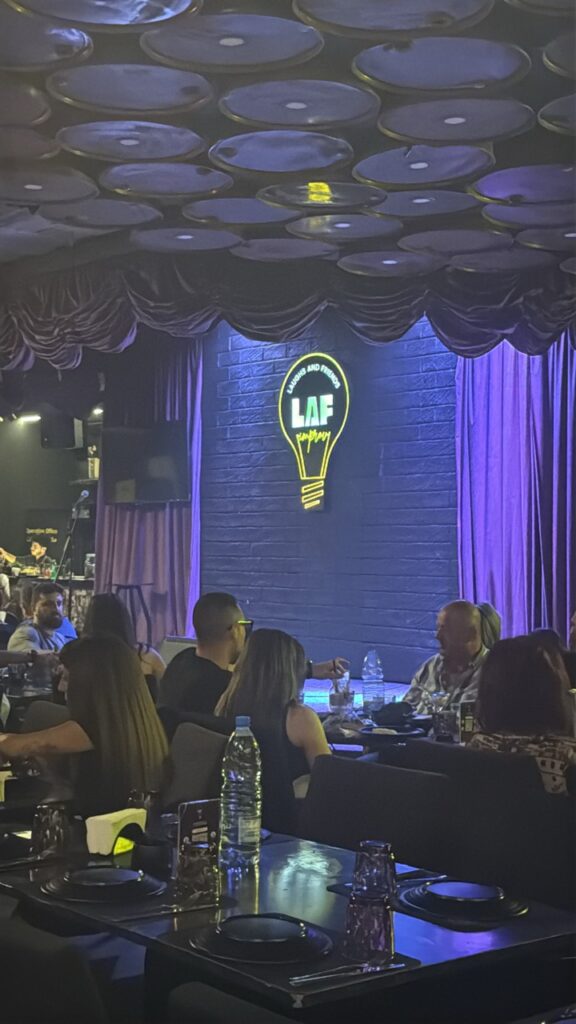
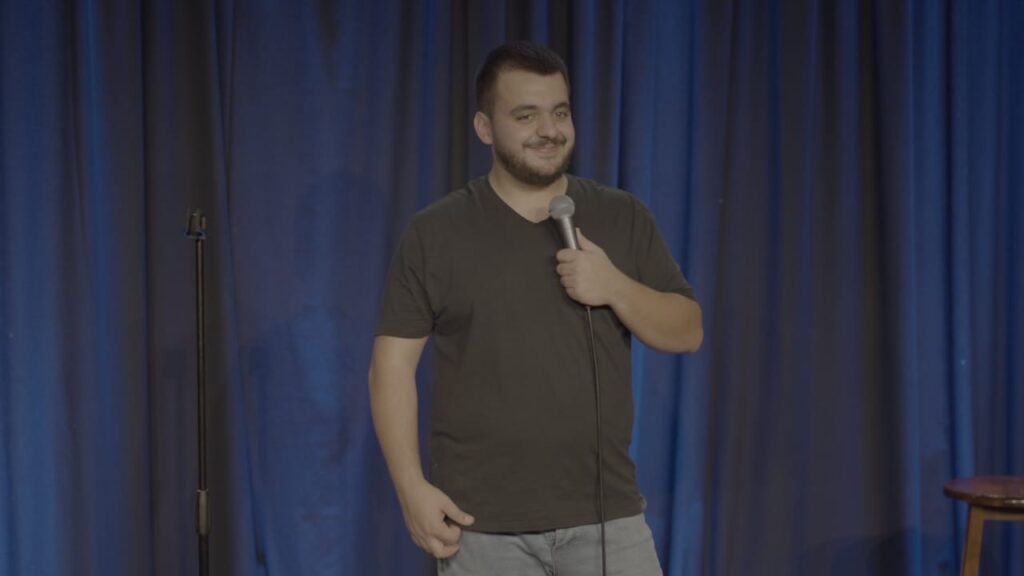
The room is dark except for strips of neon blue lighting running across the ceiling. A crowd fills almost every chair, heads turned toward two performers on a small stage. One holds a microphone, the other a guitar. People lean forward, phones appear between shoulders and somewhere between one joke and the next, an entire room breaks into laughter.
From the outside, it could be any comedy night in Beirut. There is music, a crowded room, drinks, friends sitting close together. Yet the audience has arrived carrying a country that has spent years moving between crises, economic collapse, war, displacement and the uncertainty of what comes next.
The question is what happens when that weight enters a comedy room.
For Rula Korban, who started doing stand-up in 2022, the change is difficult to measure because she entered comedy during a phase of uncertainty. “I started in the crisis. I don’t know how it was before the crisis. I mean, I don’t know the difference, because I was in the middle of the crisis,” she tells Beirut Today. Still, there is one thing she can feel from the room: “There is a thirst for laughter.”
She sees people arriving with a clear dual intention. “I feel that people come to have fun, to laugh,” she says. “And there is a desire to forget or have fun.”
That desire to forget sits alongside something more complicated. Psychotherapist Yara Khoumassi has spent time thinking about what happens when laughter enters a crisis and she draws a distinction between humor as a coping mechanism and humor as a way of avoiding painful emotions.
“When I use it to cope, I’m actually facing the really difficult, overwhelming situation,” she says. Humor, in that context, can “soften the blow” and give someone “a bit of control over something very unpredictable, very uncontrollable, very uncertain.”
The distinction matters because laughing does not automatically mean someone is avoiding what happened to them. “It doesn’t mean that if I’m laughing during a crisis, or even looking for these light things, it doesn’t mean that I don’t understand their size,” Khoumassi says. “It’s just softening a difficult situation to swallow.”
The joke after the explosion
Lebanese comedy has always had material waiting outside the door. The difference now is the sheer amount of it.
Korban says the subjects comedians approach shifted with the accumulation of crises. She does not consider herself a political comedian. “My focus is on psychology and human behavior,” she says, but politics keeps entering the room through its effect on ordinary life.
“After the war, the crisis, and even after 2019, when the economic crisis started, the explosion of the port, the wars, the topic of politics is no longer a fun topic,” she says. “It became tense, because of the division and the fatigue.”
She describes a move away from making jokes directly about politicians and toward the consequences of what they do. “They talk about the situation, not politics,” she says. “About the situation and the impact it has on us.”
Her approach to painful subjects is equally instinctive. “Everything is a joke. For me, death is the hardest thing,” she says. “The only way you can comprehend it is a joke.” Then comes the practical rule: “You read the room. You read the person in front of you.”
For Korban, that reading of the room is part of the comedian’s responsibility. “If the audience opened the door for you, if you held the right key and opened the door, the least you can do is make them laugh,” she says.
That responsibility becomes especially visible after catastrophe, when comedy must adapt to collective trauma without disappearing altogether.
The reason, she says, comes back through audience feedback. “When they tell you that they feel comfortable when they see your content or hear your jokes,” she says, “here, I feel like, yeah, when this happens, I’m really happy.”
Sam Ghazal, also a comedian, remembers a similar moment when the war interrupted live performances. “When the war came, we stopped for a while and then we came back,” he says. “I was afraid to go back, but I said that this is my life and I am going to live it.”
He then posted a joke about the situation online. The response surprised him. “I heard a lot of people saying, please come back and do a stand-up. We need something to laugh and have a good time.”
The reason people return to a comedy room remains simple for Ghazal. “Entertainment,” he says. “There is nothing deeper in stand-up, because there is no message in the comedy. I have my stories and I want to tell them.”
That insistence on entertainment is important. Some comedians resist the idea that every joke produced during a crisis has to become a form of public service.
Comedy is not a treatment plan
Nour El Hajjar is particularly direct about this. “I kind of hate how it’s marketed that comedy is therapy,” he says. “Because it’s not. It’s just entertainment with a bit of, like, tanginess or salt. But that’s all it is.”
He does not want an hour onstage to carry the weight of someone’s trauma. “I’m sorry I did not change your trauma response in one hour of laughter,” he says. “And that’s not my job.”
Hajjar has seen audience members arrive carrying experiences that are far heavier than the hour they are about to spend in a comedy room. “A lot of people, that’s been like, I don’t know, people, their siblings or family, they’re all martyrs,” he says. “I mean, they come to watch me, and they’ve enjoyed the show, and they, like, were in catharsis.” He adds, “There are people for whom, mentally, it helps them. They need that breather.”
His position is straightforward: the audience can take whatever they need from the experience. “How much reality do you want to escape? And how much do you want to connect to what you really like? I think it depends on each person, how they take it.”
Khoumassi reaches the question from another direction. She does not see humor as inherently avoidant either. In a therapy session, she says, one of the questions she might ask herself is: “What function is the humor serving?”
“Is it helping this person face the thing they need to face, or is it helping them escape it?” she asks.
That distinction can exist within the same person. Someone might need an evening where they do not think about the war. Someone else might hear a joke about something they have been unable to articulate and suddenly recognize themselves in it.
Ghazal has received that kind of reaction. His show is personal, he says, and audience members often tell him they recognize their own lives in his stories. “People say to me, ‘Bro, you said the same thing as what my parents say,’” he says. “They say the same things to me.”
He remembers another audience member whose parents told him a story they did not know how to discuss. “I’m thinking that one time, someone came to me. His parents told me the same story. They told me that they didn’t know [whom] to talk to, because they don’t want to talk about these things,” he recalls. “And when I came to them, I told them as if it was me. So, it was amazing. I was very happy.”
Comedy can give people language for something they already recognize.
The things that become ordinary
For Hajjar, who has been doing stand-up comedy for 11 years, the changing comedy landscape is also tied to how quickly Lebanese audiences become accustomed to crisis. Things that once felt shocking can eventually become part of the background of everyday life.
He gives electricity as an example.
“You can’t go about nowadays and just say like, ‘Oh my God, can you believe electricity is gone today?’” he says. “We’re all going through it every day.” The joke, then, has to move beyond the fact that the electricity is gone. Hajjar describes the process of finding the detail that can still surprise an audience inside something they have already accepted as normal. “That’s when you decide: what is the running joke?”
It is this familiarity with the absurd that gives Lebanese comedians an ever-changing pool of material. A crisis can start as something people complain about, become something they expect and eventually turn into something they recognize on stage and laugh at together.
The war pushed that further for Hajjar. His new show, “Live on the Lines,” grew out of the experience of trying to make sense of events while they were still happening. The show moves through “growing up and being an adult under genocide, under surveillance states,” alongside “the cynicism of it, the hope, nihilistic views, history of sex and identity.” The range reflects how difficult it can be to isolate one experience from another when the news keeps changing and one crisis overlaps with the next.
“So much happens in the weeks, and it’s something that you can’t keep up with,” he says. Hajjar believes the show became a way of putting some of that constantly shifting reality into material, taking experiences that were still difficult to process and giving them a place on stage.
For audiences inside Lebanon, the familiarity with crisis also changes the entry point into a joke. Hajjar says that when he performs abroad, he needs to warm audiences up first. “Here I’m like, welcome. I can just dive into it because they’ve seen shit, like lived experience.”
That shared experience creates an unusual form of shorthand. A comedian can mention an electricity cut, a political absurdity, or the latest national disaster and expect the audience to understand the reference without explanation.
Mohamad Baalbaki, who has been a stand-up comedian for almost a decade, describes a similar shift in audience attitudes. “This past year brought us a lot of new crowds,” he says, including people who had never wanted to watch stand-up live. He believes the crisis contributed to a broader opening in what people are willing to hear, alongside the influence of social media.
“We felt their core was loose,” he says. He describes comedians who pushed boundaries online, received negative reactions and continued anyway. “We broke the ice,” he says.
The result is an audience that saw more, heard more and developed a different tolerance for difficult subjects.
The room matters
Attending a comedy cannot be replicated through clips on social media.
Baalbaki puts it bluntly. “Live comedy, as a stand-up, what can I say about this video?” he asks. “First of all, the logic that starts that this is Mohamed Baalbaki on stage. I’m not watching a video of Mohamed Baalbaki. This is him live.”
“No filter, the only filter is the mixer of the microphone, there’s nothing, and that’s what makes it beautiful,” he adds.
Onstage, the audience becomes part of the material itself. “You see the interaction, you read the body language, you see how I’m talking, and the reaction,” Baalbaki says.
Hajjar reduces it to four words: “Coziness, trust, intimacy, realness … It will never replicate live any video.”
Solange Trak, an actress, filmmaker and owner of District 7 Beirut, as well as manager of Hidden Venue Comedy Club, sees this from inside the venue. “Nothing replaces the energy of a live audience,” she says. “Laughing together creates a sense of connection and belonging that you simply can’t get from a screen.”
She has also noticed the emotional shift in the audience itself. “Audiences arrive carrying a lot emotionally, but once the show starts, they become incredibly engaged,” Trak says. “The laughter feels more genuine because people truly need that release.”
Khoumassi experienced this kind of collective firsthand gathering herself during the war. Before it, she occasionally attended Poetry Night at Tota. Once the war began, she found herself going every night.
“I didn’t stop [attending poetry night],” she says. “I didn’t notice, until later, that I didn’t stop at all.”
For her, there was something particular about being in a room with other people. “There’s something about laughing together, and that communal experience that can be really important in the war,” she says. “It’s like we’re saying that we still belong here, we still have people around us, we still gather, we can still create something.”
She describes art as a “container.” A performance has a beginning, a middle and an end. “It gives boundaries, it gives structure,” she says.
What the comedian carries backstage
The audience is not the only one arriving with emotional baggage.
Baalbaki describes every performance as physically and emotionally different. “Every night is exhausting,” he says. “Every night is a new type of different emotions with different ratios. Exhaustion, exhilaration, tiredness, excitement. Every night is different. Every night is its own fingerprint. It’s like jazz music.”
For him, comedy has helped with personal experiences, although he needed distance before turning pain into material. “I needed therapy first to get over it and then joke about it,” he says. “Because I can’t joke about something I don’t understand yet.”
Once he understood it, he says, “I could distance myself from it like an elephant so I can look at it. So then I can make a joke about it.”
Then comes a sentence that carries particular weight in Lebanon: “We never heal. We keep joking but never heal.”
Khoumassi’s distinction between coping and avoidance returns here. Humor can create distance. Distance can help someone look at pain. If the joke becomes the only place where the pain is allowed to exist, another problem emerges.
Baalbaki describes his own version of that separation. “When I’m on stage, I separate. No one knows what’s going on,” he says. “It’s a switch.” Afterward, sitting at home, “everything comes back to me.”
For the audience, that switch can look effortless.
It is not.
A place to put the weight down
Trak says the role of a venue has expanded during the crises. “District 7 is a community space before anything else,” she says.
That sense of community became particularly visible during the war. “Many comedians came together to organize a fundraiser for District 7, reminding us that we’re more than a venue; we’re a family that supports one another when times are difficult,” Trak says.
That idea runs through the comedians’ descriptions of live performance too. Sam says that when someone walks into his show carrying the weight of war or displacement, he hopes they “laugh a little and have a little fun.” He also wants them to know that “there’s a safe space here where they can express themselves, laugh, and have fun.”
Baalbaki has a simpler answer when asked what he hopes someone leaves with after carrying the weight of war into his show.
“Laughter. Laughter. If there’s laughter, it’s a win.”
He explains: “It’s the hardest thing for a person to forget everything and focus on one thing for a moment.” If he can make someone listen to him for 10 minutes or an hour, “that’s a win.”
Hajjar has another hope. Asked what he would want someone carrying war, displacement or uncertainty to leave with, he answers: “The courage to accept the other perspectives that they don’t like. That’s it.”
His comedy, then, can function as a meeting point even when the audience does not agree with him.
“Definitely,” he says when asked whether comedy can confront uncomfortable truths. “It’s the easiest way to be mean, and the nicest way to say something uncomfortable.”
Laughter as a form of control
Khoumassi sees another layer beneath the shared experience: psychological freedom.
Should someone be too overwhelmed by a situation, it can make it hard to be able to make light of it. However, in some cases, they are able to find some level of “freedom” that they can use to create material.
“That little bit of freedom, psychological control that they still have, they’ll be able to use it on something that can make them laugh and make others laugh,” Khoumassi says.
She sees humor as a way of giving shape to experiences that may be impossible to explain coherently.
“In the context of counseling sessions, we often focus on putting experiences into words,” she says. “We’re asking people what happened, how they felt, what things meant to them.”
War, death, displacement and uncertainty can resist that kind of narrative. “It can be difficult to organize into this coherent narrative,” she says. “And this is where humor and other art forms can come in. You don’t have to explain the experience, just give it a shape. Humor, I think, is amazing at that.”
The collective version can feel even stronger. “There’s a difference,” she says. “The same comedy show where you put an entire stand-up show, I don’t think you’d laugh as hard as if you were watching with other people.”
Then she offers a picture of what that means emotionally: “If I’m sitting next to someone laughing from the bottom of their heart, I’m going to feel the same level. It’s what makes the human connection so rich.”
That may explain why a crowded comedy room can feel strangely significant during a period when a gathering itself can be difficult.
“We’re all going through a difficult time,” Khoumassi says, “but we’re able to come together and find this funny.”
Just for an hour
The comedians do not agree on what comedy is supposed to accomplish. Korban calls it relief. Ghazal calls it entertainment. Hajjar refuses the idea that a comedian should become someone’s therapist. Baalbaki rejects the expectation that comedians carry a social mission.
Their differences make the role of humor more interesting.
There is no single Lebanese relationship with laughter. Someone may come to a show to forget. Someone else may come because a joke gives shape to something they have been carrying. Another person may just want to sit with friends and laugh for an hour.
Khoumassi does not think these motivations have to cancel each other out.
“We try to, in these situations, we’re not preachers,” she says. “Everyone should, in a difficult situation, find something that will ease them.”
She returns to the idea of the room as a shared experience. “How nice it is that we can feel the good and the bad together,” she says.
Korban’s hope is also immediate. “I would be very honored if they said that they laughed at me,” she says. “If I can make someone laugh when they are in pain, it would be a pleasure and an honor for me.”
Hajjar is more skeptical of the larger claims people sometimes attach to comedy. “I always tell them, this is entertainment,” he says. “Don’t give it too much importance.”
Maybe that is precisely why the room works; nobody has to call it therapy.
Nobody has to call it resilience and nobody has to pretend the war has disappeared.
The lights dim, the microphone comes on, somebody tells a joke and a room full of people recognizes something in it. For a few seconds, their attention moves in the same direction.
And when the show ends, they walk back out to the bustling Beirut streets leaving the blue lights glowing above the empty chairs.

