
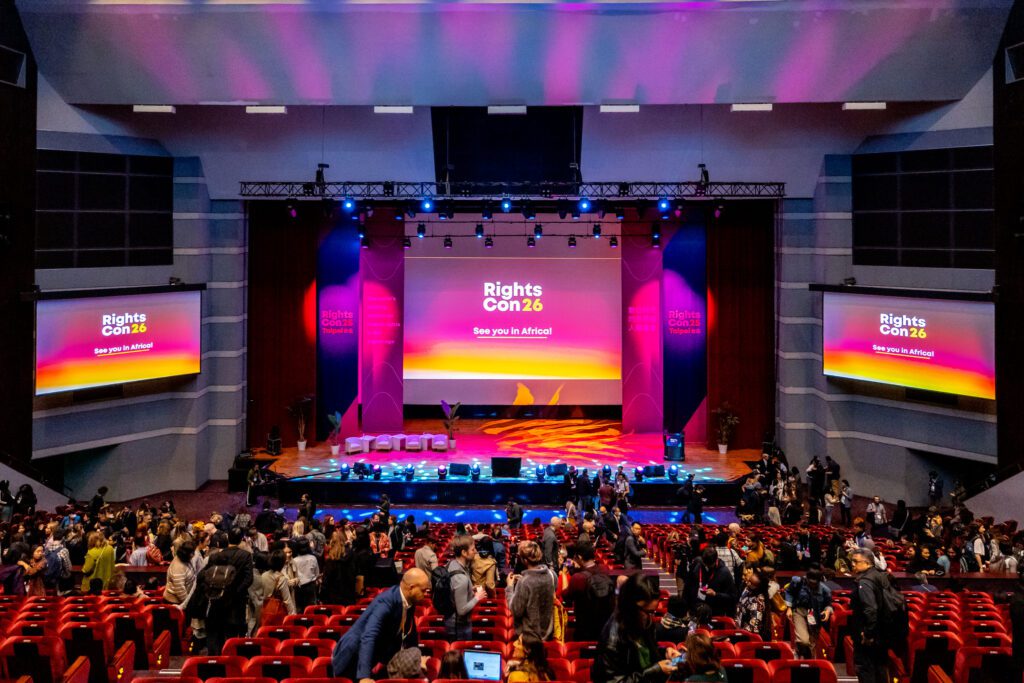
Rights Con, the annual conference on global digital rights, will not proceed in its 2026 edition. Access Now, the organization hosting Rights Con, published an announcement on May 1, 2026, stating that the conference, set to be held in Lusaka, Zambia, will not move forward, including sessions planned in online formats.
Rights Con is considered the largest annual conference on digital rights and human rights in the digital age. It convenes business leaders, policymakers, non-governmental organizations, rights groups, technologists, academics, journalists, and a wide range of other stakeholders.
Thirteen editions of the conference have been held so far, with over 40,000 participants from more than 160 countries.
Rights Con 2026 was supposed to be the first time the African continent hosted the conference. Originally planned between May 5 and May 8, 2026, the announcement of its cancellation came as a shock to many, especially as it occurred just days before its launch after months of planning.
Access Now had announced plans to welcome more than 2,600 participants in person and 1,100 online, from over 150 countries and 750 institutions.
The Reason(s) for Cancellation
The Access Now team believes that foreign interference is the reason why Rights Con 2026 will not proceed. They reported being informed that diplomats from the People’s Republic of China were putting pressure on the Zambian government due to the participation of Taiwanese civil society.
The announcement stated that, despite putting in place and working through rigorous administrative, bureaucratic, and background processes, Zambian public officials acted with limited transparency and responsiveness. This included delays in scheduling meetings, slow or absent responses from ministry channels, and announcements that the conference would be postponed – a step deemed impossible given the size and scale of Rights Con.
Access Now reported that multiple sources told them informally that the postponement would only be lifted if certain changes were made. According to the announcement, this meant that in effect specific topics would be moderated and certain at-risk communities would be excluded, including Taiwanese participation, from both in-person and online formats.
The team considered this a red line vis-à-vis their values and raised serious questions regarding the “integrity, forthrightness, and value of any future engagement based on good faith” with the Zambian government.
A Global Shock
Many human rights defenders expressed disappointment at the cancellation of Rights Con, linking it to a global trend of shrinking civic space and digital rights erosion.
“…this moment reflects a difficult and uncomfortable truth about where we stand as a digital rights community today,” said Nighat Dad, Founder and Executive Director of the Digital Rights Foundation, in a LinkedIn post that received significant engagement from digital rights practitioners. “Over the past couple of years, we’ve witnessed shrinking digital rights space and a steady erosion of our resources. And now, we are also being reminded that even our ability to gather can be disrupted or withdrawn at the very last minute.”
General elections are due to be held in Zambia on August 13, including the election of a president, members of the national assembly, councillors, and council chairs. It remains unclear how significant a role economic and political interests played in the cancellation of Rights Con 2026.

