
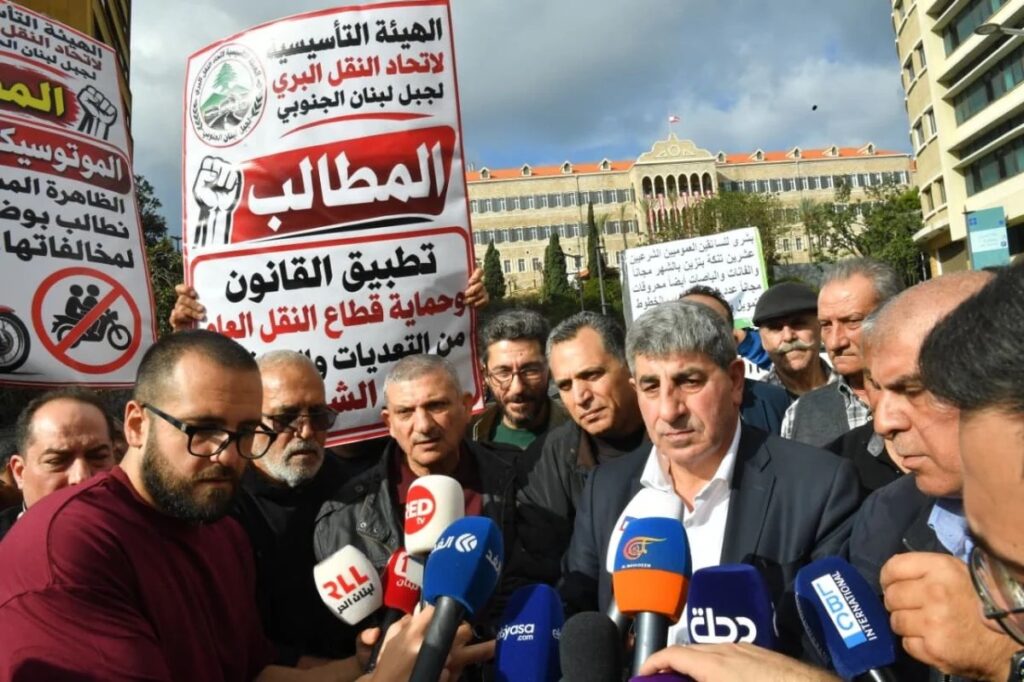
Transport workers organized demonstrations across numerous areas in Lebanon, including but not limited to Cola and Martyrs’ Square in Beirut, Bekaa, Saida, the Majdal Anjar/Rashaya intersection, Tripoli, and Aley.
The demonstrations come in the context of widespread dissatisfaction of livelihood conditions given a continued rise in transport-heavy prices. Since the start of the year, gasoline prices have risen by nearly 70%, while diesel prices have risen by approximately 94%.
Over the last years, the Lebanese government reportedly introduced multiple measures to enhance transportation conditions in the country. However, dissatisfaction remains high, with Bassam Tleiss, president of the Federation of Road Transport, highlighting in a press conference in Beirut’s Riad al-Solh Square that 54,000 families depend on the sector.
Price Hikes Continue Across Different Sector
Prices of different services and items in Lebanon have continued to rise. In September 2026, the inflation rate was 17.5% according to Trading Economics, while the October one was 16.2%.
Notably, inflation accelerated for housing and utilities, food and non-alcoholic beverages, transportation, furnishings, and household equipment and maintenance, among others, according to the platform.
The 2027 Draft Budget
Lebanon’s Ministry of Finance submitted its report on the 2027 draft budget to parliament today as well, following the Council of Ministers’ referral of the draft to Parliament on October 7, 2026.
Concerningly, however, analysis of the budget suggests little changes to the overall political economy model dominating in the country, including the prominence of regressive taxation structures and the absence of accounting for banking sector restructuring, among many other caveats.

