
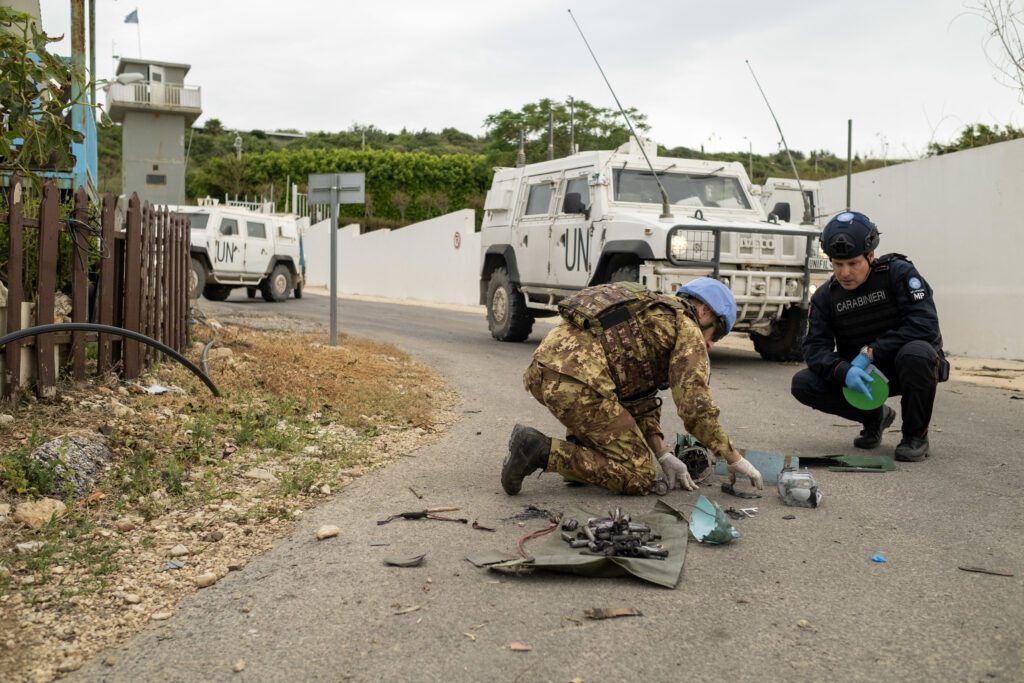
United Nations peacekeepers in Lebanon have expanded humanitarian assistance and critical infrastructure restoration efforts as violence has declined in recent weeks. Their activities include ensuring the safe passage of aid convoys and restoring essential services such as healthcare and water.
The UN Interim Force in Lebanon (UNIFIL) has helped repair and maintain water infrastructure in towns and villages across southern Lebanon and continues to neutralize unexploded ordnance, which, according to UN News, “now litter southern Lebanon and threaten local communities.”
UNIFIL announced in a press release that explosive hazards “remain one of the most serious challenges facing returning communities” and urged the parties to the conflict to comply with Resolution 1701.
Pilot Zones and Ceasefire Violations
Stéphane Dujarric, Spokesman for the Secretary-General, provided a briefing that partly focused on developments in Lebanon. Dujarric welcomed the launch of pilot zone operations in the villages of Froun, Srifa, and Zawtar Al-Gharbiya.
The briefing also noted that UNIFIL continued to observe violations of Lebanese airspace, incidents of “drones releasing munitions in proximity to civilian areas and UN positions,” and “unauthorized weapon caches and unexploded ordnance” within the mission’s area of operations.
UNIFIL referred to specific activities carried out by Israeli forces, including kinetic activity such as tank fire and small-arms fire, extensive ground operations throughout UNIFIL’s area of responsibility, and severe restrictions on the mission’s freedom of movement. These included an Israeli checkpoint near Naqoura that blocked a UNIFIL convoy for approximately three and a half hours.
The UN human rights office, led by High Commissioner Volker Türk, also announced the deployment of investigators to Lebanon to assess violations of international law by all parties to the conflict.
Healthcare services also remain severely strained, according to the UN Office for the Coordination of Humanitarian Affairs (OCHA), which reported that three hospitals and 36 primary healthcare centers remain closed, while at least 17 hospitals have sustained damage.
Froun, Srifa, and Zawtar Al-Gharbiya are the first areas where the mediated framework agreement is to be tested. The Lebanese Army is expected to assume responsibility for security in these areas and demonstrate that the military presence of non-state actors, a reference to Hezbollah in the agreement, has been removed. Israeli forces are expected to withdraw from these zones progressively, with that process likely to be conditional on the successful implementation of the pilot arrangements in the first villages.
These developments come shortly after talks in Rome last week, where various stakeholders discussed implementation plans for the agreement, particularly the pilot zone arrangements.

