
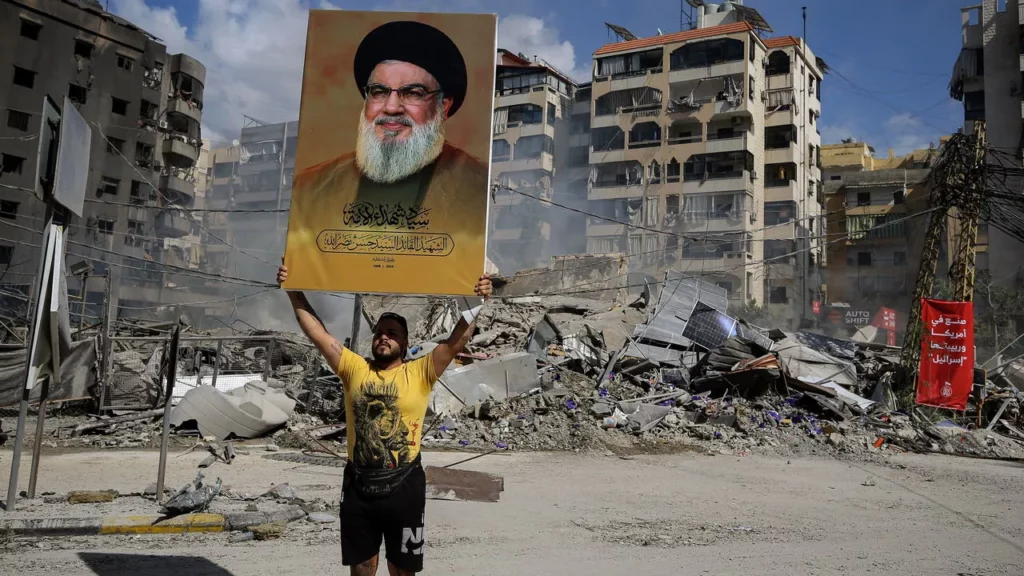
It is known how ideology shapes a person’s thinking and how it instills “non-negotiables,” shaping our understanding of the world in a singular way. It offers us a compass of values and morals. One important aspect of building and consolidating an ideology or movement is its symbols. For instance, the leader of the Palestinian Liberation Organization (PLO), Yasser Arafat, was largely viewed as the symbol of Palestinian struggle despite his controversial stances throughout his political career, especially during the Oslo Accords. In those years, he was a key figure who rallied Palestinian hopes and aspirations; during times of crisis, Arafat was portrayed as a resilient survivor, and his courage and steady composure elevated him to iconic status. This is due in part to Arafat’s charisma and his ability to connect with audiences. Identifying a symbol and perceiving this figure as somebody similar to “us,” a man we could meet on our streets, adds an extra push.
In Lebanon, political parties survive on symbols. Each of our streets carries a flag representing a political party or militia, enshrined in the neighborhood. Our walls are covered in graffiti, political slogans, and photos of our leaders. It is commonplace, almost comical, to see this now: life in Lebanon often feels like a continuous political rally, void of any meaning except our blind mobilization.
It is widely argued that Hezbollah created, over decades, a mystical character out of its former Secretary-General, Hasan Nasrallah. Combining the religious and the military resulted in the creation of an untouchable—almost godly—public persona.
I was in Hamra when the news of his assassination was confirmed. The sounds of wailing, crying, and screaming echoed along the street. This is when it became clear to me that Hezbollah succeeded in creating its lasting symbol. For 32 years, Nasrallah was portrayed as synonymous with resistance and victory, even going as far as using his name, which translates to “victory of God.” On several posters celebrating the liberation of Lebanon’s South in 2000 from the occupying Israeli army, or reminders of the group’s 2006 victory against the same enemy, Nasrallah and the resistance were fused as one.
Founded after the Israeli invasion in 1982, Hezbollah was enthusiastically backed by Iran’s Islamic Revolutionary Guard Corps (IRGC). Heavily funded by Iran, the party’s military capacities were more sophisticated and developed than those of the Lebanese National Resistance Front (LNRF), a coalition of Lebanon’s leftist organizations and parties. Although the LNRF carried out several joint operations against Israel’s occupation in Lebanon, at the time, Israel was mainly fighting secular and nationalist resistance groups such as the LCP, the SSNP, Fatah, and the Popular Front for the Liberation of Palestine (PFLP), among others.
Hezbollah gradually emerged as the primary resistance force against foreign occupation. It carried out large-scale operations such as the bombing of the U.S. Marines in 1983 and the attack on French paratroopers, which ultimately led to the withdrawal of both American and French forces from Lebanon.
The gradual restriction of power exercised on leftist and secular resistance groups, notably the Communist Party and the Syrian Social Nationalist Party, both former allies under the Lebanese National Resistance Front, at the tail end of Lebanon’s civil war resulted in Hezbollah’s emergence as the singular entity and the only armed resistance actively fighting the Israeli occupation in southern Lebanon.
Hezbollah’s monopolization of resistance in Lebanon meant that the party benefited largely from the country’s sectarianism and mastered playing such divisive dynamics to its benefit. It also meant the gradual Islamization of the movement and, more widely, resistance as a cause. Islamism, like any other form of religious fundamentalism, reinforces the idea of an “Other,” which further fragments an already divided society. Instead of cultivating and nurturing national unity around resistance and a shared enemy, Hezbollah’s Islamization further polarized public discourse around the group and its purpose. By shifting the resistance’s identity and values from national liberation to religious empowerment, Hezbollah alienated its non-Muslim counterparts. By rendering liberation as synonymous with religious rites, Hezbollah succeeded in shrinking the possibility and the successes, of collective resistance.
Perhaps the greatest mistake of Lebanon’s secular parties and resistance groups was believing that liberation, in and of itself, could excuse the erosion of their own ideological foundations. Under the banner of resistance and liberation, segments of Lebanon’s secular parties and former leftist movements gradually folded into Hezbollah’s orbit, choosing efficacy over coherence. In doing so, they dismissed the party’s explicit ideological grounding: its organic ties to Iran and its framing of resistance through a distinctly Islamist lens. What was once a national, pluralistic struggle was slowly recast and saw its language, symbols, and legitimacy reshaped. In accepting Hezbollah as the sole vehicle of resistance, these groups did not just compromise tactically; they tacitly conceded to the Islamization of resistance itself, allowing a cause that once belonged to all to be redefined in narrower, exclusionary terms.
Of course, Hezbollah’s monopoly of anti-imperial resistance is the consequence of an absent and elusive national Lebanese identity not predicated on religious association. The history of any country has a founding myth. This myth aims to strengthen belonging to the land or to the entire nation, while justifying its reasons for existing and creating a unified identity around an imagined community. This same myth brings citizens together around a common narrative that every citizen can identify with by recognizing a shared past and aspiring toward a common future. The founding myth of Greater Lebanon only brings together two factions of society: the Druze and the Maronites, the historical inhabitants of Mount Lebanon, or what was once considered the “refuge of minorities.” This narrative inevitably excludes other cultural and religious groups in Lebanon who cannot fully relate to this version of historical identification.
The failure to create a Lebanese national identity has, in turn, intensified sectarian identities. Religious political parties, such as Hezbollah and the Lebanese Forces, have drawn on this reality to entrench their existence and power within the state.
In his seminal book Being Arab (2005), journalist Samir Kassir writes that “the idealization of resistance per se… prohibits any debate on the means that should be employed.” The blind idealization and glamorization of resistance, along with the creation of larger-than-life figures as symbols, has left us oblivious to its nuances. It has created a taboo around the question of resistance itself and, more precisely, what forms it can and should take.
Absorbing Hezbollah’s narrative and rhetoric around national resistance has had significant consequences. It is packaged with religious and political axes that are near-sighted and disastrous for Lebanon. It has de facto alienated individuals and groups due to its religious circumscription and its close ties to Iran, which has rendered the matter of Israel’s persistent desire to occupy Lebanese land a subject of political debate rather than a safeguarded national objective.
Like any religious, political, and armed movement, Hezbollah’s ideology poses great risks to Lebanese society when left to its own devices, especially given the limits of the state and its multi-confessional reality.
The political developments we have witnessed in the Levant over the past fifteen months have proven once again that resisting Israeli occupation and Western imperialism is a right. Although this resistance is legitimate in and of itself, it must draw its legitimacy from the people. Foreign powers have historically used political parties in Lebanon as proxies and points of entry to navigate and control the region for their own ambitions. With no clear national identity, it becomes easier to fall for glamorized rhetoric around resistance.
In Prison Notebooks (1930), Italian thinker Antonio Gramsci writes that a “crisis consists precisely in the fact that the old is dying but the new cannot be born; in this interregnum a great variety of morbid symptoms appear.” This “interregnum” could be the last opportunity for Lebanon’s left and secular movements to regain their role on the political scene and reposition themselves as a national movement uniting under a shared identity while resisting Israeli occupation and the imperial interests it seeks to advance.
Resistance is not rigid. It can, and should, continuously evolve to meet society’s needs and aspirations. It should represent the collective vision of a nation and, most importantly, unite people in their pursuit of liberation. It is time to initiate serious dialogue around our national identity. What is Lebanon? What do we stand for as a collective? What do occupied territories in South Lebanon mean to us? How do we move forward with a neighboring expansionist entity eager to appropriate land and heritage? And, above all, what does it mean to be Lebanese in the absence of religious association?
The views expressed in this article are those of the author and do not necessarily reflect the position of Beirut Today.

